Article: Summer Dog Feeding: Routines for Hot Weather
Summer Dog Feeding: Routines for Hot Weather
Warm weather changes how a dog eats, usually before an owner notices. Appetite dips, water goes down faster than it used to, food left standing turns quickly, and the routine that worked all winter starts to fit badly. None of that is a problem to solve so much as a rhythm to adjust, and most of the adjusting takes a few minutes.
This is a practical guide to feeding a dog through a British summer: when to put meals down, how to keep water genuinely fresh, what to do when the bowl comes back half full, and how to stop food spoiling in a warm kitchen.
Why Summer Changes a Dog's Appetite
Dogs eat to fuel two things: activity and body temperature. In cold weather both draw on the same bowl, which is why winter appetites tend to be robust. In summer the second demand largely disappears, walks get shorter or move to the edges of the day, and the result is a dog that simply wants less food. A mild, temporary drop in appetite during a hot spell is ordinary.
What is worth watching is the pattern rather than a single skipped meal. A dog that eats enthusiastically at seven in the morning and ignores the same bowl at six in the evening has not gone off its food, it has told you when it would rather eat. Most summer feeding problems are timing problems wearing a disguise.
Meal Timing for Hot Weather
The simplest change, and the one that makes the most difference, is to move meals towards the cooler ends of the day. Early morning and later evening suit most households, and they tend to line up with when walks have moved to anyway.
Two habits are worth keeping alongside that. Leave a gap between a meal and vigorous exercise in either direction, which is sensible practice year round and easier to observe in summer when the middle of the day is quiet regardless. And keep the schedule consistent once you have chosen it. Dogs settle into a routine quickly, and a predictable mealtime does more for a hesitant summer appetite than any change of food.
Water Is the Part That Actually Matters
If you change one thing this summer, change how often the water bowl is refreshed. A dog's water intake rises sharply in warm weather, and a bowl that stood untouched for a day in February will be emptied and refilled several times in July.
- Refresh rather than top up. Rinse and refill, so the bowl is not carrying yesterday's dust and saliva under a fresh inch of water.
- Put water in more than one place. A second bowl in the room the dog actually sleeps in during the day removes the need to walk across a hot house for a drink.
- Keep it out of the sun. A bowl on a sunny floor warms up fast and becomes unappealing long before it becomes a problem.
- Stainless steel and porcelain hold up best. Both wipe clean properly and neither takes on a smell in warm weather the way a scratched plastic bowl can.
Our bowls come in porcelain and 18/10 stainless steel, both dishwasher safe, which makes a daily rinse a genuinely small job rather than one that gets skipped.
Portions When the Appetite Drops
Resist the urge to fix a smaller summer appetite by making the food more tempting. Adding toppers or switching brands mid-heatwave teaches a dog that holding out produces something better, and the habit outlasts the weather.
Split the daily amount into smaller, more frequent servings instead. Two or three modest meals suit a reduced appetite better than one large bowl, and less food sits out at any one time. Put the bowl down for a set period, then lift whatever is left rather than leaving it to stand. In a warm kitchen, wet food left out for hours is the thing most likely to cause an upset stomach, and it is entirely avoidable.
If a dog is drinking normally, behaving normally and simply eating a little less through a hot week, that is ordinary. A dog that is off both food and water, or off its food for more than a day or two, is a question for your vet rather than for an article.
Keeping Food Fresh in a Warm Kitchen
Heat is hard on dog food, and dry food is not as immune as it looks. The fats that make kibble palatable are the first thing to turn, which is why a bag that smelled fine in spring can smell stale by August.
- Store the bag somewhere cool and dark, away from the oven, the window and the conservatory.
- Keep food in its original bag, inside a container, rather than tipped loose into one. The bag carries the barrier lining, the batch code and the best-before date.
- Buy a smaller bag in summer if the usual size takes more than a few weeks to finish.
- Refrigerate opened wet food, use it inside a couple of days, and never serve it straight from a bowl that has stood out.
- Wash bowls daily. In warm weather the film that builds up on a bowl left overnight is doing more than looking unappealing.
Where the Bowls Sit
Feeding station placement matters more in summer than at any other time of year. Move the bowls out of direct sun and off any floor that gets hot, and choose a spot with some through draught rather than a sheltered corner. A dog that is uncomfortable where it eats will eat less, and the fix is often as simple as moving the bowls two metres.
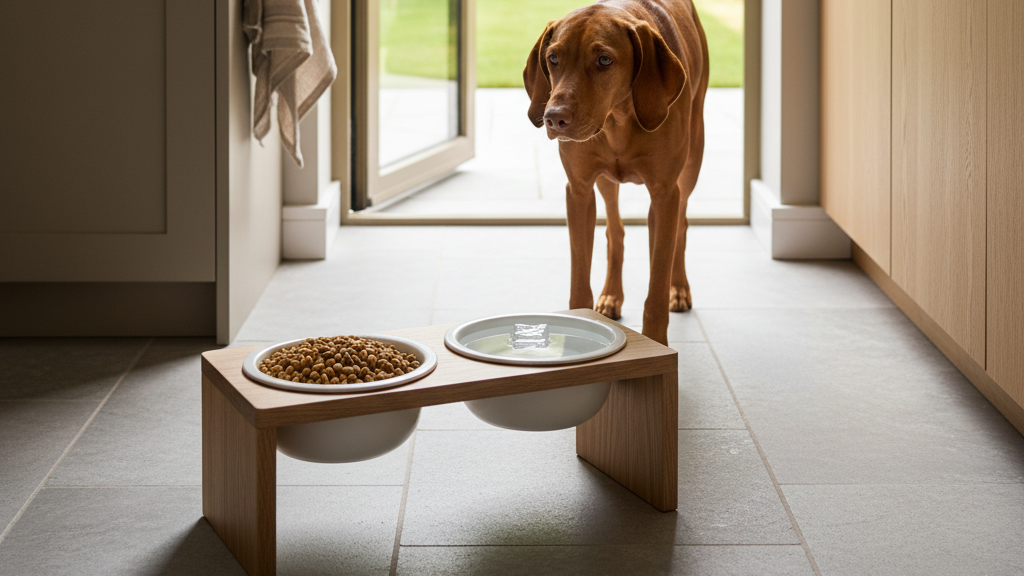
Height is worth checking while you are there. A dog eating from the floor should be able to stand square, without splaying its front legs or dropping its head below its shoulders to reach the bowl. For a tall dog, raising the bowl towards elbow height removes that stretch. Measure from the floor to the elbow, the joint where the front leg meets the body, and keep the bowl rim close to that height.
Days Out and Travel
Summer is when dogs eat away from home most often, and it is when routines slip furthest. Carry water and a collapsible bowl for anything longer than a short walk, and offer it before the dog looks like it needs it. Keep to the usual food rather than picking something up locally, since a change of diet on a hot day is a poor combination. On a long car journey, feed lightly before setting off rather than a full meal, and offer water at every stop.
If your dog eats reluctantly in an unfamiliar place, bringing its own bowl helps more than most owners expect. Familiar equipment is one of the few things you can keep constant when everything else about the day is new.