Article: Multi-Pet Households: Feeding Solutions That Prevent Food Guarding
Multi-Pet Households: Feeding Solutions That Prevent Food Guarding
If two heads are bent over the same bowl in your kitchen each evening, you already know how quickly mealtime can sour. A low growl, a stiffened back, a dog hovering near the cat's dish, these small moments tell you that someone in the household feels their dinner is at risk. Food guarding sits behind most of it, and the answer is rarely louder discipline. It's a question of how the room is laid out at six o'clock.
Why do pets guard their food?
Food guarding is rarely about temperament. It's about scarcity, real or imagined. Even a calm, well-socialised dog can tense up if another animal hovers too close to their bowl, and cats are no different, just subtler about it. They don't square up. They walk away from a half-finished bowl, eat at odd hours, and quietly drop weight while you wonder what's wrong.
The signals differ by species. Dogs lean over the bowl, eat at speed, or position themselves between the food and a perceived rival. Cats refuse to come down when another pet is nearby, abandon a bowl mid-meal, or eat in nervous bursts at midnight when the house is quiet. Both are saying the same thing. This resource feels unsafe.
Once you read the behaviour as a security issue rather than a discipline issue, the response changes. You stop trying to correct the dog and start arranging a feeding setup where neither pet has anything to guard.
How far apart should pet feeding stations be?
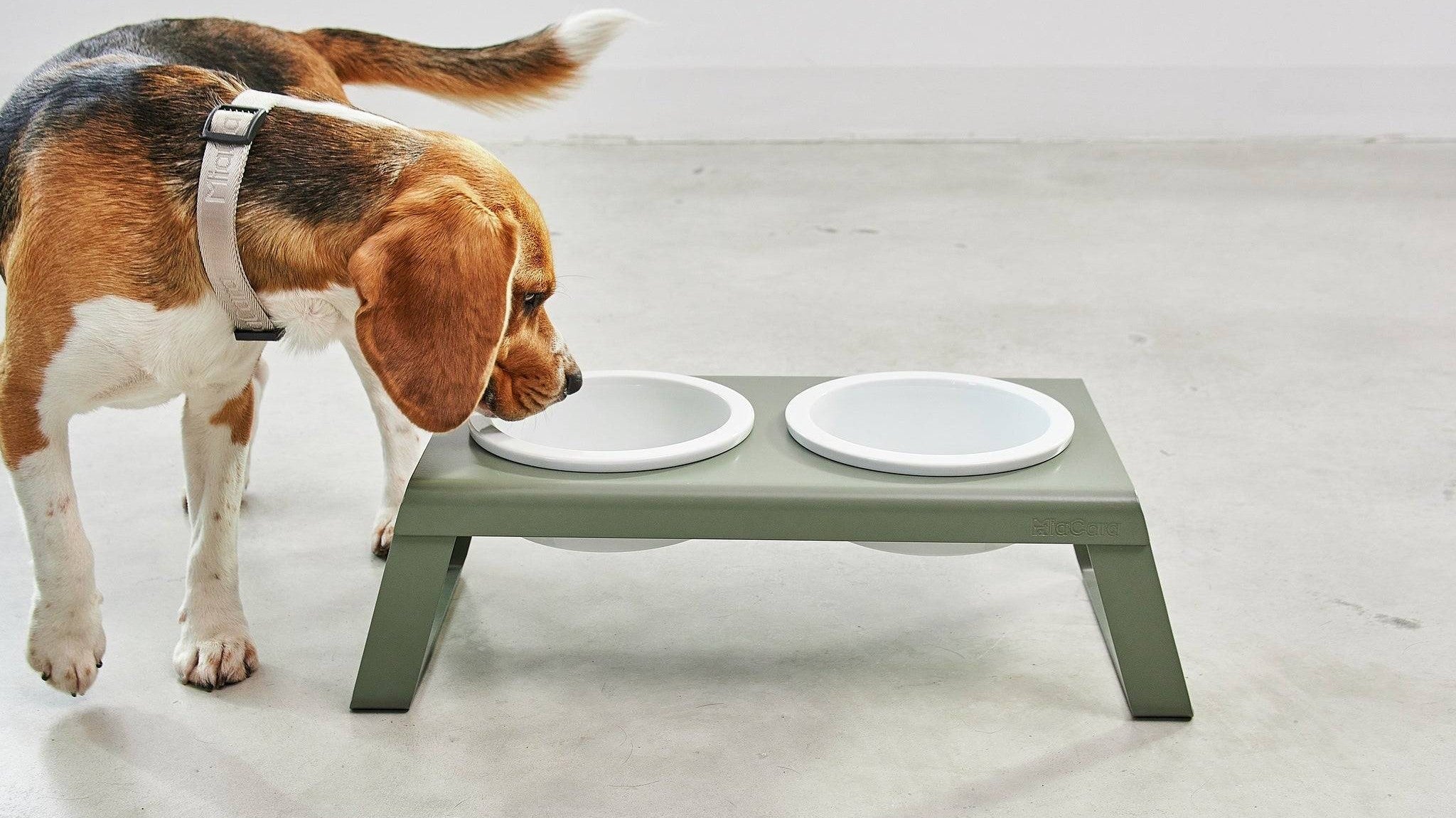
A simple lift off the floor does more work than most people realise. Raised feeders give a dog ergonomic relief on the spine and neck, but they also make the bowl feel less like contested ground. The bowl has its own pedestal, its own outline, its own piece of the room. Pets read that visual cue.
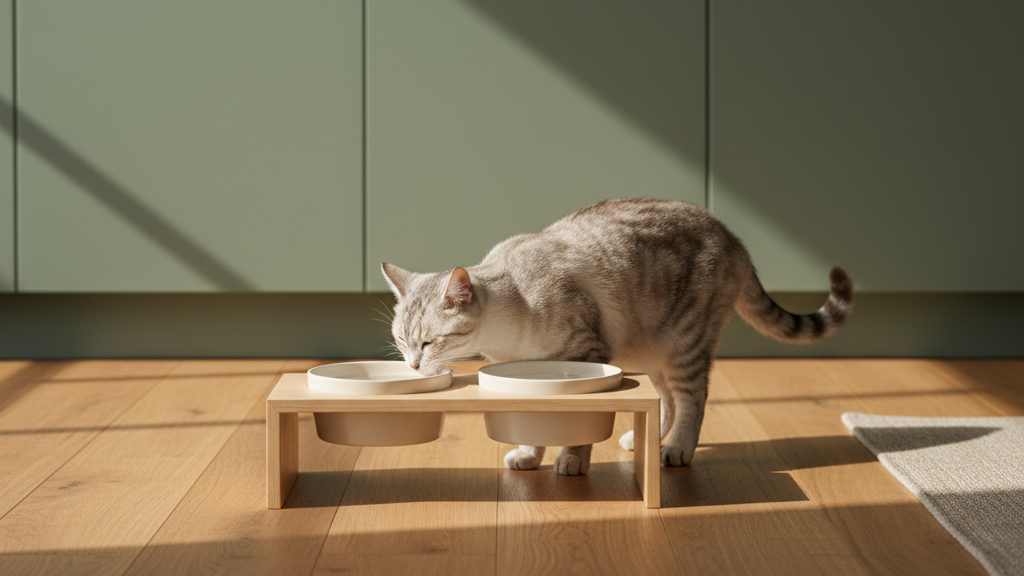
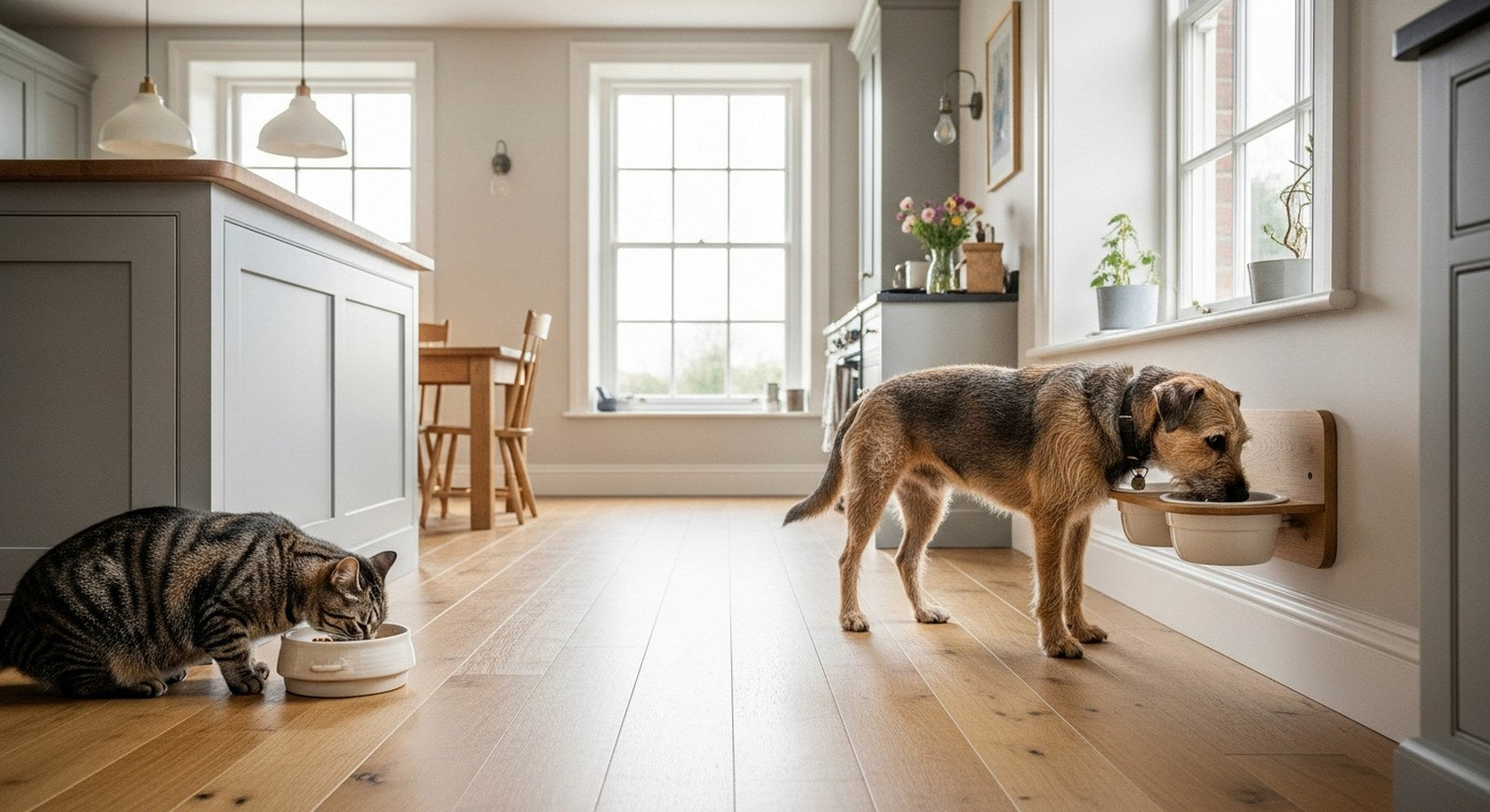
The Desco Dog Feeder (or the Desco Cat Feeder for the cat half of the household) handles this with porcelain or stainless steel bowls set into a slim powder-coated frame, a quiet shape that sits in a kitchen without dominating it. For a softer profile in a tighter corner, the Arco Dog Feeder (with the matching Arco Cat Feeder for mixed-species households) takes up less visual weight while doing the same job.
Placement does the rest. A metre of clear space between feeders is the minimum, more if your dogs are big or your cats are nervous. Tuck anxious eaters into a corner so their back is covered. Confident eaters can take the centre of a kitchen wall without trouble. If a doorway leads straight to the food zone, turn the feeder so a passing pet does not loom over it.
One Pet, One Station
The most reliable fix for guarding is the simplest. Each animal gets their own feeding station, in their own spot, every meal. Think of it as separate tables rather than a shared canteen.
You do not need to rearrange the kitchen for it to work. A piece of cabinetry, a low bench, even the corner of the island can break a sightline cleanly enough that pets stop tracking each other. Dogs that used to inhale their food often slow down once they can no longer see another bowl. Cats start finishing their portions instead of nibbling and bolting.
The pattern only holds if it stays the same. Pets settle into a routine fast, but they unsettle just as fast if the bowl moves around. Once a station is in place, leave it there. The familiarity is half the calming effect.
Cats and Dogs in the Same House
Mixed households need a bit more thought about geography. The simplest fix is the most reliable one. Feed the cat somewhere the dog isn't. That can be a separate room with the door closed for the duration of the meal, a corner of the kitchen behind a baby gate the cat can hop over, or the opposite end of an open-plan space with the kitchen island acting as a sightline break.
The result is the same in each case. The cat eats unhurried, the dog can't see the cat's bowl, and the temptation to muscle in disappears. Once the meal's done, the room reverts to normal and everyone gets on with their evening.
The bowl itself matters too. Lightweight plastic skitters across hard floors and pulls a curious dog straight to the noise. A weighty hand-thrown piece like a Wirksworth ceramic bowl stays where you put it, takes a wash without scuffing, and keeps the room from sounding like an aluminium can being kicked across the tiles.
Speed and Timing
If one pet eats fast and the other grazes, you have a problem of pace, not posture. Slow-feeder bowls and puzzle mats stretch a dog's meal from a rushed minute to several. By the time the dog finishes, the cat has had room to settle.
Staggered timing works just as well. Feed the quicker eater first, in a separate space, then bring out the slower eater. The cost is two minutes of orchestration. The return is a household where no one is watching anyone else's bowl.
For severe cases, feeding in genuinely separate rooms isn't a defeat, it's the right answer. Some dogs will never feel safe eating in the same space as another pet, and that's a fact about the dog, not a failure of training.
When You Want More Help
Microchip feeders open only for the assigned pet, which solves the secondary problem of dogs hoovering up the cat's leftovers. They earn their keep when one pet is on prescription food, weight-management food, or medication-laced food.
Automatic timer feeders deliver portions on a schedule, which keeps the routine predictable even when you're not in the kitchen. They're most useful in households where the human's day is unpredictable but the pets' day shouldn't be.
A reliable wait command is worth as much as any piece of equipment. Two seconds of stillness before a dog approaches the bowl resets the dynamic from rush to ritual. It also gives you the window you need to put the cat's food up out of the way before the dog moves.
Materials and Maintenance
The surface food sits on matters more than people give it credit for. Porcelain and stainless steel hold neither smell nor stain, which keeps a meal appetising rather than slightly off. Plastic does the opposite, and a faintly sour bowl is a quiet way to make a sensitive eater turn down dinner.
Hardwood bases age well and don't slip. Look for joinery that's tight from new, because a feeder that wobbles under a large dog gets pushed across the floor at every meal until it eventually drifts out of position.
Once a week, lift the bowls out, run them through the dishwasher, and wipe down the frame. That's the whole maintenance routine for a well-made feeder.
Holding the Line
The reason these setups work isn't the equipment, it's the predictability. Pets relax around food when food behaves the same way every day, in the same place, at roughly the same time, on the same surface. Once that rhythm holds, guarding usually fades within a few weeks, and you'll notice it because the kitchen gets quiet at six o'clock instead of charged.
Watch for small slippages. A new puppy, a holiday, a kitchen reshuffle, any of these can knock a calm routine sideways for a week or two. Reset deliberately rather than letting things drift, and the household lands back where it was.
A considered feeding setup gives every pet a place that's clearly theirs and a meal that arrives the same way every day. The result is a quieter house and better-fed animals, in a kitchen that still looks like the kitchen you wanted.
Multi-pet feeding: quick answers
How do I stop food guarding between my pets? Give each animal its own feeding station, in the same spot, every meal. A stand-alone pedestal or a clear sightline break, a piece of cabinetry, a low bench, even the corner of an island, works because the bowl no longer feels like contested ground.
How far apart should pet food bowls be? A metre of clear space between feeders is the minimum, more if you have big dogs or nervous cats. Tuck anxious eaters into a corner so their back is covered, and give confident eaters the centre of a wall instead.
Should cats and dogs be fed in the same room? It works best if the cat eats somewhere the dog cannot see or reach: a separate room with the door shut, a corner behind a baby gate the cat can hop over, or the far end of an open-plan space with an island acting as a sightline break. Once the meal is done the room can go back to normal.