Article: Why Do Cats Purr? What Your Cat Is Telling You
Why Do Cats Purr? What Your Cat Is Telling You
Most people hear a purr and call it a day. Happy cat, job done. The truth is a little more interesting than that, and a little more useful, because a purr is not one thing. It's a sound your cat makes in at least four distinct contexts, only one of which maps neatly onto contentment. Read it without the rest of the picture and you'll miss things. Read it alongside tail position, ear angle and eye softness and you'll understand your cat considerably better than most people who've lived with one for years.
Why do cats purr? The four things it actually means
Contentment is the obvious one, and it's real. Your cat is stretched out in a warm spot, slow-blinking, body loose, and the purr is quiet and low. That one's straightforward. The others are worth knowing.
Solicitation purring is the version designed to get something out of you. Researchers at the University of Sussex identified a particular type of purr that cats produce specifically when they want food or attention: it embeds a high-frequency cry within the lower purr frequency, which humans find harder to ignore than a standard purr. Your cat didn't work this out consciously. It simply learned, over time, that this particular sound produces results. If your cat parks themselves in front of you at 6am making a sound that is both pleasant and somehow insistent, you've heard it.
The third context is self-soothing. Cats purr when they're stressed, unwell, at the vet or somewhere unfamiliar. It's thought to be a self-regulatory behaviour, a way of managing anxiety or discomfort. This is the one that most confuses people, because a purring cat is not always a comfortable one.
The fourth is mother-and-kitten communication. Kittens can purr within days of birth, and the exchange between a nursing queen and their litter is one of the earliest uses of the sound. It works as a contact signal and a reassurance, close-range and quiet, at a stage when neither mother nor kittens want to be making much noise.
The body language you need alongside the purr
The purr tells you something is happening. The body tells you what.
The tail is the easiest read. Tail straight up, gently curved at the tip: your cat is relaxed and sociable. Tail low or tucked: they're not. Tail puffed: genuinely alarmed, regardless of whether they're making any sound at all. A cat with a flicking tail and a steady purr is a cat in two minds, and you'd do well not to push your luck.
The ears are nearly as clear. Forward-facing ears paired with a purr and relaxed posture is the full set of signals that says settled and content. Ears rotated back or flattened, even slightly, is the body contradicting the purr. You're probably in the window between fine and not fine, and it's sensible to give them room rather than push for more contact.
The eyes do the nuanced work. Slow blinking from a purring cat is about as close to a declaration of ease as you'll get. Dilated pupils can mean excitement or stress, and you need the rest of the signals to know which. Hard, fixed stare: leave them alone.
Posture and muscle tension are the last piece. A truly relaxed cat is loose in the body, slightly boneless, often rolled partially onto one hip. One that's purring but holding tension, weight forward, muscles engaged, is not fully at ease. The purr may be genuine or it may be self-soothing. Either way, they're not asking for interaction.
When a purr is not what it looks like
The version people most often misread is the stress purr, because it runs directly against expectation. You pick your cat up. They purr. You assume they're happy. They're managing. The signals to look for alongside: body held rigid rather than relaxed against you, ears angled back, tail curled tightly in rather than loose, no slow blinking. Any of those alongside a purr and you're holding a cat who'd rather be elsewhere. Put them down.
The solicitation purr is harder to misread but worth recognising for what it is. It's a finely tuned manipulation, and it works. Knowing that doesn't make it less effective at 6am, but it does mean you can make a deliberate choice rather than just responding automatically. Some cats escalate from solicitation purring to full vocalisation if ignored; others simply wait it out. Both are valid strategies, from their perspective.
There's also the question of silence. Some cats purr rarely and some purr constantly, and both are normal. A cat who has never been a big purrer is not less content than one who broadcasts all day. Individual variation is wide. What matters is the shift: a cat who has always purred freely and stops, or one who suddenly purrs through situations that previously didn't prompt it. Changes in pattern are more informative than the baseline.
Giving your cat somewhere worth settling
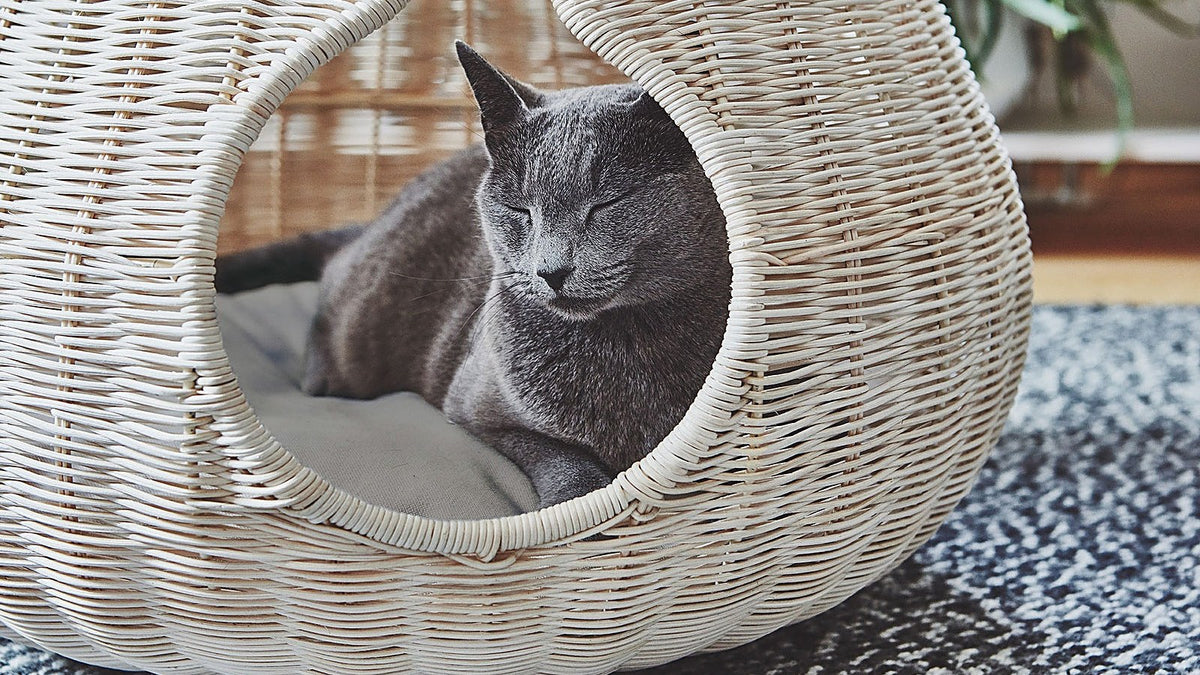
Cats purr most readily when they feel secure, which has a practical consequence. A cat with a quiet, consistent resting place they have chosen for themselves spends more time in the loose, settled state the contented purr belongs to. Cats are particular about surfaces. Most prefer something that holds warmth, has a slight give, and is positioned with a clear view of the room.
The MiaCara Senso Cat Bed is a good example of a bed cats actually use rather than politely ignore. The bouclé upholstery is the kind of looped, textured surface that cats knead into and settle against, and the structured raised rim gives them an edge to lean into while holding its shape. The inner cushion cover is machine washable, which matters more than it sounds once you've lived with it for a year.
For cats who prefer to stay low and tucked away rather than perched, the MiaCara Loggia Cat Cave is a wool felt cave on a slim frame with an open front, so a cat can hide and still watch the room. Some cats will pick a cave over an open bed every single time, particularly if they share the house with a dog or a busy household. You probably already know which you're dealing with. The rest of the cat beds collection covers both kinds.
We stock the German design house MiaCara because their beds are made to be lived in rather than looked at, which is a harder thing to get right than it sounds. Whichever you choose, put it somewhere your cat already likes, leave it alone, and see where they end up.
Frequently asked questions
Why does my cat purr and then suddenly scratch or bite me?
This is called petting-induced overstimulation. Cats have a threshold for physical contact that's often lower than we assume, and the signals that the threshold is approaching, a flicking tail, ears rotating back, skin rippling, are easy to miss when you're focused on the sound. The purr doesn't switch off before the scratch arrives. Watch the tail and ears as you stroke, and stop before the signals escalate.
Is purring always a sign my cat is healthy and content?
Not always. Cats purr in several different states, contentment being just one of them. The sound needs context: look at the whole picture, not just the noise.
My cat barely purrs. Does that mean something is wrong?
Some cats are simply quiet, and a low-purring cat isn't necessarily unhappy or unwell. The more useful signal is a shift from your cat's usual pattern, rather than the baseline itself.