

Article: Cat Scratching: What They're Really Doing to Your Furniture
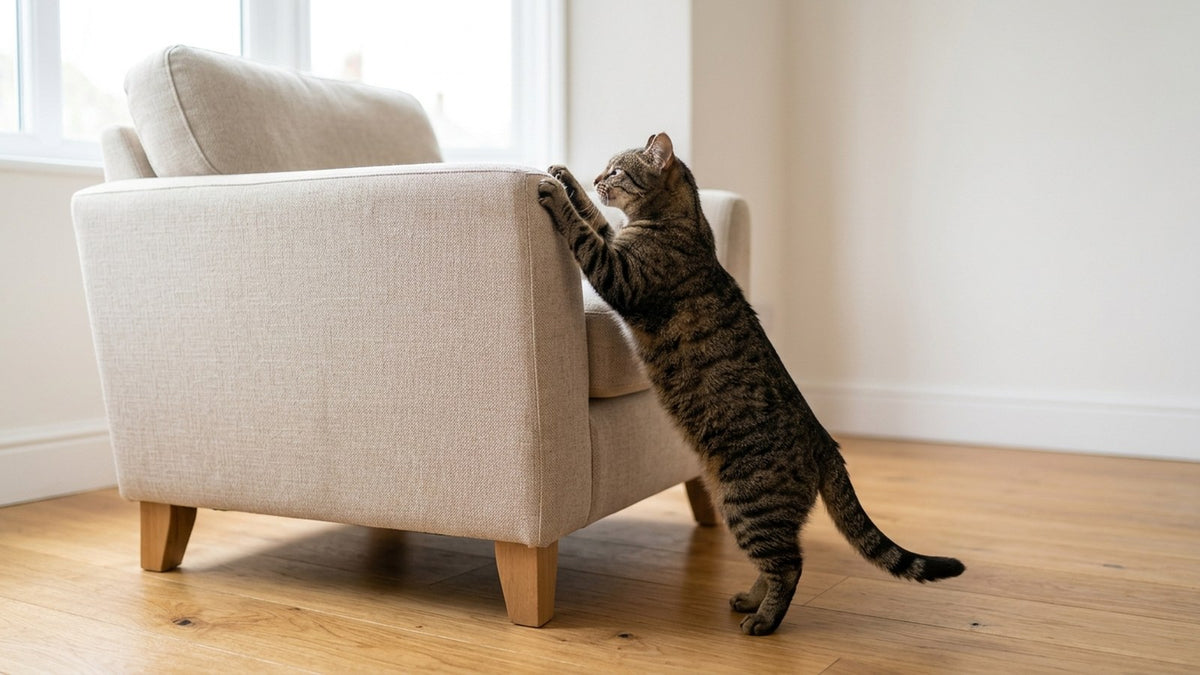
Cat Scratching: What They're Really Doing to Your Furniture
A cat dragging its claws down the arm of the sofa is not being naughty, and it is not really about the sofa either. Scratching is one of the most hard-wired behaviours a cat has, and furniture usually only becomes the target because it happens to be the tallest, sturdiest, most convenient thing standing in the room. Understanding what the behaviour is actually doing for the cat is the only way to redirect it without a fight neither of you will win.
It is claw maintenance, not damage for its own sake
The claw a cat scratches with today is not the same claw underneath. International Cat Care explains that the dragging motion, sometimes called stropping, "loosens and removes the outer keratin husk of their claws, revealing sharp new surfaces underneath." A cat that never scratched anything would be left with worn, blunt claws rather than tidy ones, so this part of the behaviour is routine grooming, not destructiveness.
It is also how a cat marks territory
Scratching leaves more than a visible mark. Cats Protection notes that "scent glands between the paw pads produce a unique smell which is left on surfaces when cats scratch," so every scratch is doubling as a signal to any other cat that might pass through the room, whether or not one actually will. Tall, prominent furniture near a doorway or a well-used route through the house is exactly the kind of spot that message is meant to be left in, which is a large part of why the sofa arm gets chosen over a quiet corner.
And it is a stretch, not only a scratch
International Cat Care lists muscle exercise alongside claw care and marking as one of the three reasons cats scratch, describing it as a way to "exercise the muscles in their front legs and spine." The RSPCA gives the same three-part picture: cats "naturally use objects to scratch, mark territory, strengthen muscles and sharpen their claws." That is why a cat reaching up the side of an armchair is usually pulling itself into a full-length stretch at the same time, front paws extended as high as the surface allows, rather than scratching in a low crouch.
Why the behaviour cannot be trained away, only redirected
International Cat Care is direct about this: "your cat should never be punished. If the motivation for scratching is claw maintenance or communication, then you're punishing a natural behaviour which is very confusing for your cat." Shouting, spraying water or moving a cat away from the sofa does not remove the underlying reason it scratches there. It only teaches the cat that scratching in front of you is risky, which tends to push the behaviour toward moments when nobody is watching rather than stopping it. Cats Protection's own advice points the other way: "praise your cat when they scratch a post and ignore them when they scratch inappropriate objects," rewarding the behaviour you want rather than only reacting to the behaviour you don't.
Giving the behaviour somewhere better to go
Placement decides whether an alternative actually gets used. International Cat Care's advice is to put a scratching post or panel "in an area where your cat spends a lot of time," and specifically near the furniture that is already being scratched, since a cat that has to walk past a favourite target to reach a new option will usually keep choosing the target. Cats Protection adds that cats often scratch and stretch right after waking, so a post or panel near a favourite bed tends to catch that moment naturally.
Orientation and texture matter as much as location. Some cats scratch on a vertical surface, dragging their claws downward the way they would on a sofa arm or a door frame; others prefer to work horizontally, along a rug or a low surface. Cats Protection recommends matching this preference rather than assuming every cat wants the same tall vertical post, and being generous about the surface: "it should be tall enough for your cat to scratch at full stretch," which lets the same full-body stretch the cat was already getting from the furniture carry over to the new option.
A wall-mounted panel is a genuinely different shape of answer to a free-standing post, and worth considering for anyone whose cat targets the arm of a sofa or a doorframe specifically rather than open floor space. The MiaCara Pannello Cat Scratch Panel is built with a steel frame and a scratching surface of moulded, high-density recycled fibre, mounted directly to the wall at whatever height suits the cat rather than taking up floor space the way a post does. Positioning it at the same height and in the same part of the room as the furniture being scratched, rather than tucked into an unused corner, is what makes the difference between an alternative a cat ignores and one it actually chooses.
If you are planning wall space for your cat more broadly, our guide to planning a floor-to-ceiling climbing route covers how to plan wall shelves as one route around the room.
Patience is part of the method
A new scratching surface rarely gets adopted on day one, and that is expected rather than a sign it has failed. Keeping the old target briefly less appealing (a throw draped over the arm of the sofa, for instance) while the new surface sits in a good spot, and rewarding the cat when it does use the new option, gives the switch time to take. Removing the alternative or moving it to a "tidier" spot after a week of disuse is usually what causes a redirect to fail, not the cat's preferences.
Frequently asked questions
Is my cat's scratching a sign something is wrong?
Almost always no. Claw maintenance, territory marking and muscle stretching are all normal, expected behaviours, not symptoms of a problem. What is worth watching is a sudden, marked increase in scratching in one particular spot, which can sometimes track alongside a stressful change in the household, such as a new pet or a change to the home. The scratching itself is not the issue in that case; whatever is unsettling the cat is.
Where should I put a scratching post or panel so my cat actually uses it?
Next to, or very close to, whatever is already being scratched, not tucked away in a spare room. Cats generally scratch near where they spend time and right after waking, so a spot near a favourite chair, doorway or bed gets used far more reliably than a well-meant option placed somewhere quieter and tidier.
Should I punish my cat for scratching the furniture?
No. Scratching is a natural behaviour, and punishing it does not remove the reason the cat is doing it, only the willingness to do it in front of you. Redirecting to a well-placed alternative, and praising the cat when it uses that alternative, works far better than telling a cat off for something it cannot simply stop doing.