
Article: Cat Wall Shelves: How to Plan a Floor-to-Ceiling Climbing Route
Cat Wall Shelves: How to Plan a Floor-to-Ceiling Climbing Route
Most people buy a cat wall shelf and then wonder where to put it. One shelf at shoulder height, and your cat ignores it or uses it once and moves on. The problem isn't the shelf. It's that a single shelf isn't a destination. Cats don't want a perch. They want a route, a way of moving through vertical space that feels intentional and secure. Planning that route takes about twenty minutes of thinking before you buy anything, and it changes everything about how well the finished result works.
Why vertical space matters more than floor space for cats
Height isn't a luxury for cats. It's a behavioural need. Cats are both predator and prey, and a high vantage point lets them watch a room without feeling exposed. International Cat Care makes the same point: cats are natural climbers that need to rest and watch over their surroundings from high places, because that is where they feel safe. Given the choice, most cats will take the highest comfortable spot available and settle there.
Where your cat chooses to rest tells you a lot about where they feel safe. If yours is consistently sleeping on top of the fridge or the highest bookshelf they can reach, they're not being eccentric. They're finding the best they can work with. A properly planned climbing wall gives them something better: reliable vertical territory that's theirs, with routes they can repeat and positions they can predict.
How to plan the route before you buy a single shelf
Start with the wall, not the product. Stand in the room and work out where the route begins and ends. The floor entry point matters most, and the most reliable route starts at floor level and needs no furniture at all, so your cat can use it whether or not the sofa is where it was yesterday. For a fit adult cat, a first step around 30 to 40 cm off the floor works well.
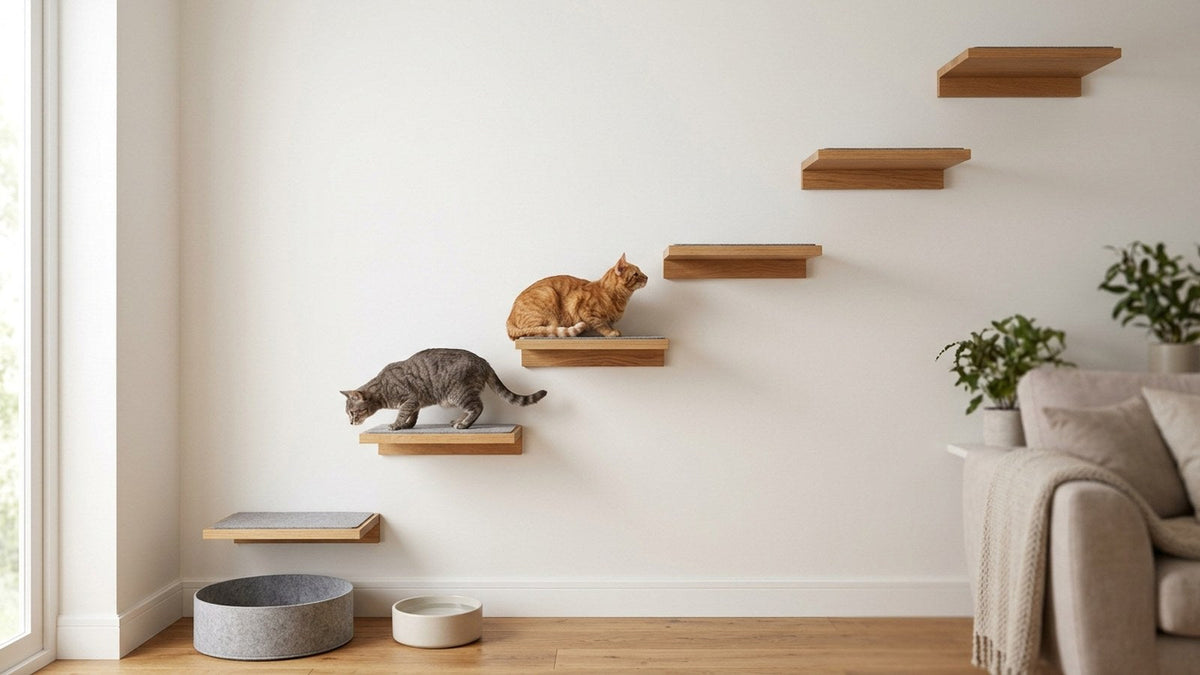
From there, plan in steps of 20 to 30 cm of vertical rise between each element. That is an easy step rather than a jump: comfortable to repeat several times a day and gentle on the joints. For kittens, older cats, or heavier cats, reduce every gap to 20 to 25 cm and use more, closer steps rather than fewer, bigger ones. A fit adult cat can manage up to about 45 cm between two secure, generous shelves, but treat that as the exception rather than the plan. A route that feels a little too easy still gets used, while one with a jump that feels uncertain gets avoided.
There is one arrangement to avoid: never stack steps directly on top of one another. A straight vertical ladder leaves your cat nowhere to place its paws to the side. Offset each element 15 to 30 cm sideways from the one below so the route zig-zags up the wall. Beyond that, diagonal, diamond, triangle or staggered all work, so arrange them to suit the wall and the room you have.
The Cat Wall Step from Cat's Atelier is the component that solves the most common layout problem: the awkward gap between two shelves where there's nothing in between. Drop one into the middle of a gap that's too big, and a single uncertain leap becomes two easy steps. If you find yourself sketching a layout and spotting a 50 cm reach somewhere in the middle of it, add a step there before ordering anything else. The Round Sisal Cat Wall Step does the same job, in triple-braided sisal rope over a solid wood core.
Think about the destination too. The top of the route should land somewhere genuinely satisfying: above a door frame, alongside a window, or at a corner where two walls meet and your cat can see the whole room. Anywhere above about 1.5 m reads as proper vantage height. Leave roughly 30 cm of clear headroom above the top perch so your cat can sit up and turn comfortably. To try a route before you buy, our cat wall planner lets you pick a shelf, add steps and see the layout drawn as you go.
Choosing shelves that work as a system
The individual shelves you choose matter less than how they connect, but that doesn't mean they're interchangeable. Different shapes suit different positions in a route, and you can see the full range in the cat shelves and climbing collection.
Wider, flatter shelves make excellent resting points and destinations. The Softly Shaped Cat Wall Shelf is 60 cm long and 37 cm deep, which is generous enough for a cat to stand, turn and settle rather than simply pass through. Put it where you want your cat to actually stop.
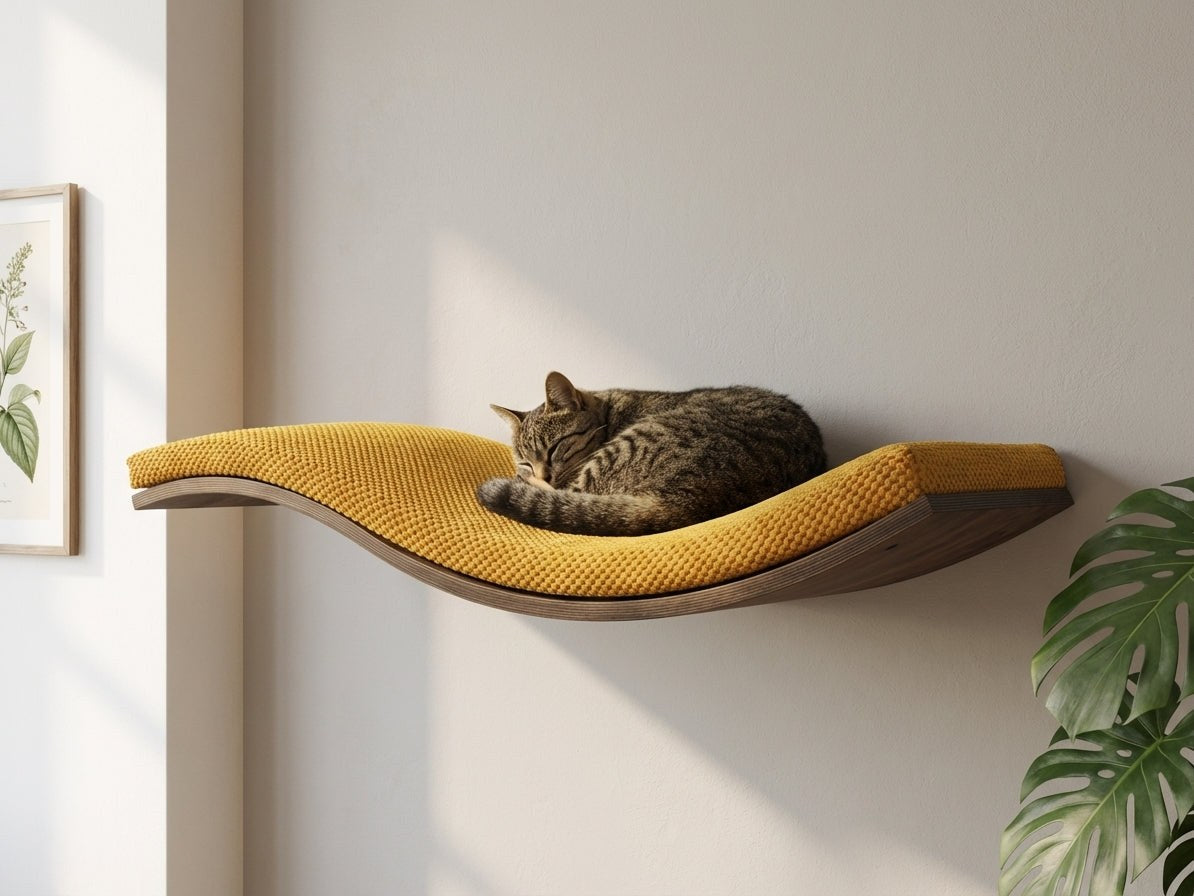
Shaped and curved shelves are the most popular choice for a resting spot at height. The Arcing Haven Cat Wall Shelf has a continuous dip that many cats like to curl into, and it comes in 60, 75 and 95 cm widths so you can match it to the wall you have. For more shelves a cat can sleep on, see our wall-mounted cat beds.
The Wave Cat Wall Shelf works differently. Its shape creates a natural directional flow, which makes it a good mid-route connector where you want your cat moving through rather than stopping. Position it between the lower entry steps and the upper resting point and it reads as part of the route rather than a separate object on the wall.
Cat's Atelier shelves are made in Poland, and the Arcing Haven and the Wave are hand-finished there. Every shelf arrives with concealed fixings and the full fittings included, and mounts to masonry or to a plasterboard wall with studs. The load ratings are the reassuring part: the Softly Shaped is rated to 25 kg, and the Arcing Haven and the Wave to 25 kg or 40 kg depending on size. A cat lands with force rather than settling gently, so a rating several times your cat's weight is exactly what you want underneath them.
Working around a room without disrupting it
A climbing route doesn't have to run straight up one wall. The better ones usually don't. Using two walls gives you a corner destination at height, which cats reliably prefer because it limits the directions anything can approach from. It also breaks the route up visually, so it reads as part of the room rather than a project someone bolted to the wall on a Saturday afternoon.
Consider how the route interacts with existing furniture. A path that connects sofa back, mid-height shelf, and then climbs above the bookcase before the wall shelves take over gives your cat multiple entry and exit points rather than one fixed path. Multiple exit points matter: cats often won't commit to a route if they can only leave the same way they came in.
One thing to plan for that most guides skip: the descent. Cats are less confident coming down than going up, and a route that flows beautifully in one direction can create a bottleneck in the other. Keep the downward steps in the same 20 to 30 cm range as the climb, and if any drop would land on a surface smaller than your cat's body length, add a connecting step. A skipped descent means a cat sitting at the top, waiting for someone to move the sofa closer. They will wait longer than you'd expect.
Frequently asked questions
How far apart should cat wall shelves be?
A vertical rise of 20 to 30 cm between each shelf or step suits most cats. That is an easy step rather than a jump. For kittens, older cats, or heavier cats, reduce every gap to 20 to 25 cm and use more, closer steps. A fit adult cat can manage up to about 45 cm between two secure, generous shelves, but that is the exception rather than the plan: a route that feels too easy still gets used, while one with a jump that feels uncertain gets avoided entirely.
How high should a cat climbing wall go?
As high as your ceiling and fixings allow. Anywhere above about 1.5 m reads as proper vantage height, and if a full ceiling run isn't practical, aim to get at least one destination shelf into that band. Leave roughly 30 cm of clear headroom above the top perch so your cat can sit up and turn.
Do cat wall shelves need to be on the same wall?
No, and routing across two walls usually produces a better result. It creates more than one exit point from the system, which cats strongly prefer. It also spreads the fixings across more wall area, which gives you more choice about where each shelf lands.
Planning a cat wall as a Christmas present? Our Christmas gift guide for cats and dogs brings together the complete cat wall sets, with the last order dates for Christmas delivery.