Article: How to Choose a Leather Dog Collar: A Buyer's Guide
How to Choose a Leather Dog Collar: A Buyer's Guide
Two leather dog collars can look almost identical on screen and behave completely differently after a year of daily wear. The difference is rarely the price. It comes down to four things: how the hide was tanned, which part of the hide was used, what the hardware is made of, and how the whole thing was stitched together. Get those right and a collar softens and deepens with age. Get them wrong and it cracks, stretches and gives up.
Start with the tanning, because it decides everything else
Leather isn't one material. The tanning process changes its structure, and there are two main routes.
Vegetable tanning uses natural plant compounds, traditionally tree bark, over a period of weeks. You get a firmer, more structured hide that holds its shape, moulds gradually to your dog's neck and develops a patina as it ages. It's the traditional method for saddlery and harness work, so it's what gets used when leather has to survive years of tension and weather.
Chrome tanning uses mineral salts and takes about a day. It gives you a softer, more pliable, more colour-consistent leather at lower cost, which is why most mass-market leather goods use it. If you want something supple from the first day, it's the better process.
For a collar, the trade-off usually favours vegetable tanning. A collar spends its life under intermittent load, gets wet, dries out, and rubs against fur in the same places every single day. A denser hide copes with that better, and it tends to age into something nicer instead of something tired.
Every leather collar we stock is vegetable-tanned. That was a deliberate buying decision, not a coincidence.
Why bridle leather is the benchmark
Within vegetable-tanned leather, bridle leather sits at the top. It's full-grain hide, so the outer surface is intact instead of sanded back and coated over, and it's stuffed with waxes and oils during finishing. That's where the moisture resistance and the characteristic firmness come from.
The name is literal. It's the leather used for bridles and reins, where failure isn't an option. A bridle leather collar starts stiff, and that puts some people off in the first week. Give it a month of walks and it'll have taken the shape of your dog's neck.
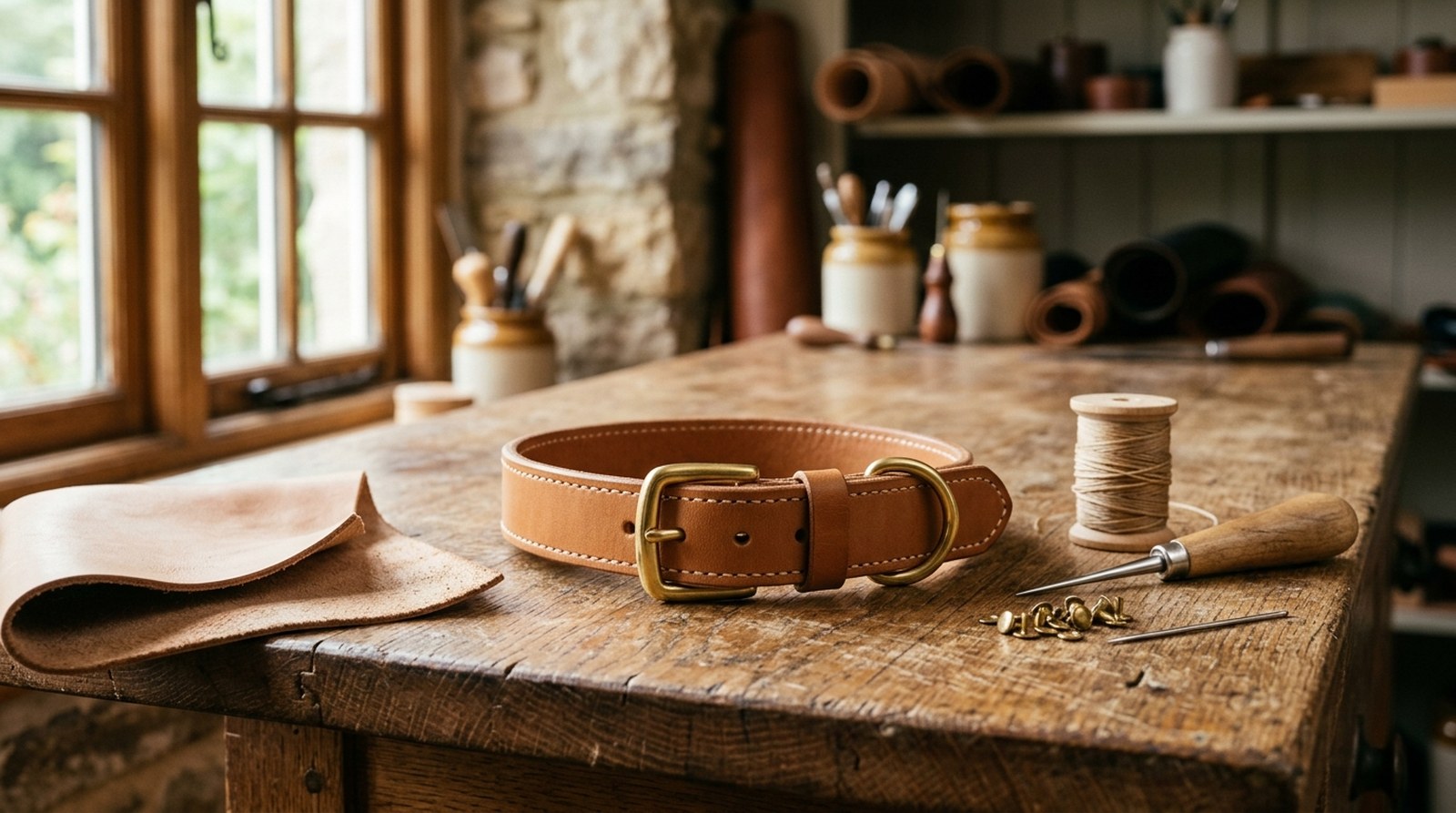
The Cub & Grey Leather Dog Collar is cut from British bridle leather and vegetable-tanned using traditional methods. It comes in six sizes covering necks from 10 to 24 inches, so the same construction works for a terrier or a labrador.
Hardware: look for solid metal, not plated alloy
Hardware is where corners get cut most often, because a buckle photographs the same whether it's solid metal or plated zinc alloy. Across the wider market, zinc alloy is the usual budget choice, and it can crack under sharp load. So the most useful question you can ask about any collar is what the buckle is actually made of.
On the Cub & Grey Leather Dog Collar you choose between two, both fitted by hand:
- Solid brass: it won't rust, it wears to a warm, softly aged tone, and it's strong all the way through, not just on the surface. It's the traditional choice for working leather goods.
- Nickel-plated steel: on the Cub & Grey Leather Dog Collar this option pairs the strength of steel with a brighter, cooler plated finish that stays looking new for longer.
Both are sound. Choose on looks, and on what suits your dog's coat. Neither one is meaningfully stronger for everyday use.
How it's stitched matters more than how it looks
Machine stitching uses a lockstitch: a single thread looping through itself. It's fast and it's neat, and if that thread gets cut anywhere along the seam, the seam can unravel from that point.
Hand stitching, done properly, uses two needles working from both sides, so every hole holds two independent passes of thread. Cut one and the rest stays put. On a collar taking a dog's weight against a lead, that's the point of it.
Waxed thread is the other detail worth looking for. The wax helps the thread resist water and abrasion where it sits proud of the leather. Cub & Grey hand stitch every piece with waxed thread in their Worcestershire workshop, and because each collar is cut individually, no two are quite the same.
Padding and lining: when a softer collar makes sense
A plain, unlined bridle leather collar is the most hard-wearing option, and once it's moulded to shape most dogs find it perfectly comfortable. Some dogs do better in a lined collar: fine or short coats, sensitive skin, or a dog who wears a collar all day and not only on walks.
Two options from the German design house MiaCara are worth knowing about here. The Siena uses vegetable-tanned leather with light padding in a fine wool blend, chosen because wool regulates temperature and resists odours. The Fano is a vegetable-tanned full-grain slip collar with a padded leather inner lining and an adjustable slip-stop buckle, designed by Thea Drying and handcrafted in Europe.
Getting the fit right
Fit is where most collar disappointment starts, and it's the easiest thing to get right. Measure your dog's neck with a soft tape where the collar will actually sit, then leave room for two fingers underneath. Buy for that measurement and not for the breed, because two dogs of the same breed can differ by several centimetres.
Sighthounds are the one real exception. A greyhound, whippet or lurcher has a neck wider than its head, so a standard collar can slip straight off over the ears. They need a wider, shaped hound collar instead, and we've written separately about why sighthounds need a different collar.
Every collar product page carries its own measuring guidance and size chart, so check there before you order instead of working from a general chart.
What a good collar does over the first year
A vegetable-tanned collar isn't finished when it arrives. It's at the start of something.
- Weeks one to four. Stiff at first, then it starts to take the curve of your dog's neck.
- Months two to six. The colour deepens, most noticeably on the lighter tans. Small marks stop sitting on the surface and start blending into it.
- Beyond six months. The leather has firmed up and settled into shape. Brass hardware takes on a softer tone.
Keep it out of prolonged soaking where you can, and if it does get thoroughly wet, let it dry naturally away from direct heat. Conditioning it occasionally with a leather balm keeps the fibres supple.
Personalisation
Stamping is the durable way to personalise leather. The letters are pressed into the hide itself, so there's no printed layer to wear off. Cub & Grey offer up to eight characters stamped directly into the collar, which covers most dogs' names.
It's worth deciding at the point of ordering, though, because a stamped collar can't be un-stamped.
What to check before you buy
Vegetable-tanned full-grain leather, ideally bridle leather. Hardware that's solid metal, and a product page that tells you so. Hand stitching with waxed thread. And your dog's actual neck measurement, taken with a tape instead of guessed from the breed. A collar built that way is one of the few things you'll buy for a dog that genuinely improves with use.
You can see our full range of dog collars and leads, or start with the Cub & Grey Leather Dog Collar.
Frequently asked questions
Is vegetable-tanned leather better than chrome-tanned for a dog collar?
For a collar, usually yes. Vegetable tanning gives you a firmer, denser hide that holds its shape, moulds to your dog's neck over time and ages into a patina instead of wearing out. Chrome-tanned leather is softer from day one and cheaper to produce, which suits products that need to be supple immediately, but it doesn't develop in the same way under the repeated load and moisture a collar sees.
What is bridle leather, and why is it used for dog collars?
Bridle leather is full-grain, vegetable-tanned hide that's been stuffed with waxes and oils during finishing. It's the leather traditionally used for bridles and reins, so it's built to hold up under years of tension and weather. Those same properties, density, moisture resistance and the ability to mould to shape, are exactly what a collar needs.
Should I choose brass or nickel hardware on a leather dog collar?
Choose on looks. Solid brass won't rust and wears to a warm aged tone. The nickel-plated steel option on the Cub & Grey Leather Dog Collar gives a brighter, cooler finish that stays looking new for longer. Both are strong enough for everyday use, so the more important question is whether the hardware is solid metal at all, or a plated alloy that can crack under sharp load.