Article: Cat Trees for Large Cats: How to Choose One That Stays Put
Cat Trees for Large Cats: How to Choose One That Stays Put
A big cat changes what a cat tree has to do. A Maine Coon, a Norwegian Forest Cat or simply a long, heavy moggy lands with more force, stretches further and needs more room to lie down than the cat most trees are designed around. The result is familiar: a tree that rocks when the cat jumps on, a top platform they spill over the edge of, and a post too short to stretch against. A cat that does not trust a piece of furniture tends to stop using it.
This guide is about choosing a tree a large cat will trust. It comes down to three things, in this order: how steady the tree is, how much room the beds give, and how long the scratching surface is. Height comes last.
What "large" means for a cat tree
There is no official size at which a cat becomes "large", and breed alone does not settle it: two cats of the same breed can differ a great deal in length and weight. What matters for furniture is how your own cat moves. Watch how far they stretch when they wake up, how much of a sofa cushion they take when they lie flat out, and how heavily they land when they jump down. That tells you more than a breed chart, and each one matches a check below.
Stability first: weight in the base matters more than height
Cats Protection's advice on scratching posts puts it simply: choose one "with a heavy, stable base so it doesn't wobble or topple during use" (Cats Protection). The same logic applies to a whole tree, and it applies more to a large cat, because a heavier cat jumping onto an upper bed puts more sideways force through the structure.
The practical test is weight relative to height. A tall, light tree is a lever; a heavy base keeps it planted. When you compare trees, look for the product's own weight figure, not just its dimensions, and be wary of any listing that gives height but no weight at all.
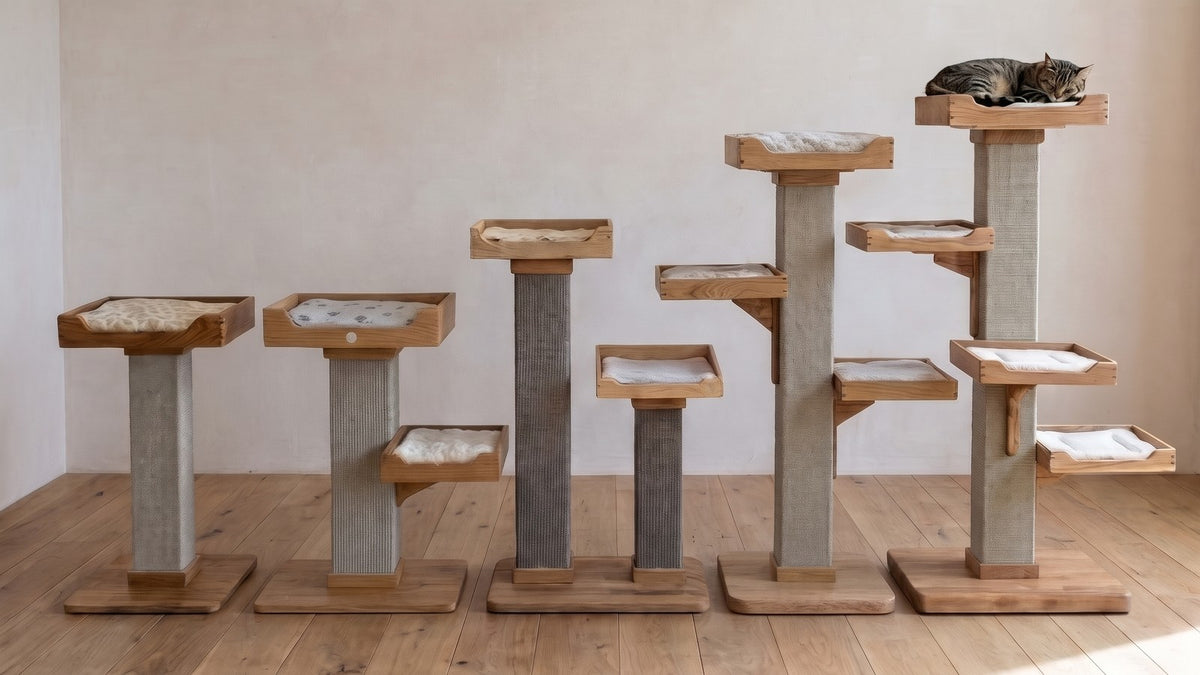
Our handmade oak cat trees take this approach. The base and the beds are solid oak, which is what gives each tree its weight: about 20kg in all for the one-bed tree (90cm tall), about 22kg for the two-bed tree (90cm), about 26kg for the three-bed tree (135cm), and about 30kg for both the four-bed tree (158cm) and the two-post tree (110cm). Each is handmade to order by a cabinet maker in Scotland, and carries a five-year structural guarantee on the base, posts and beds (the post covering and cushions are not included in that guarantee).
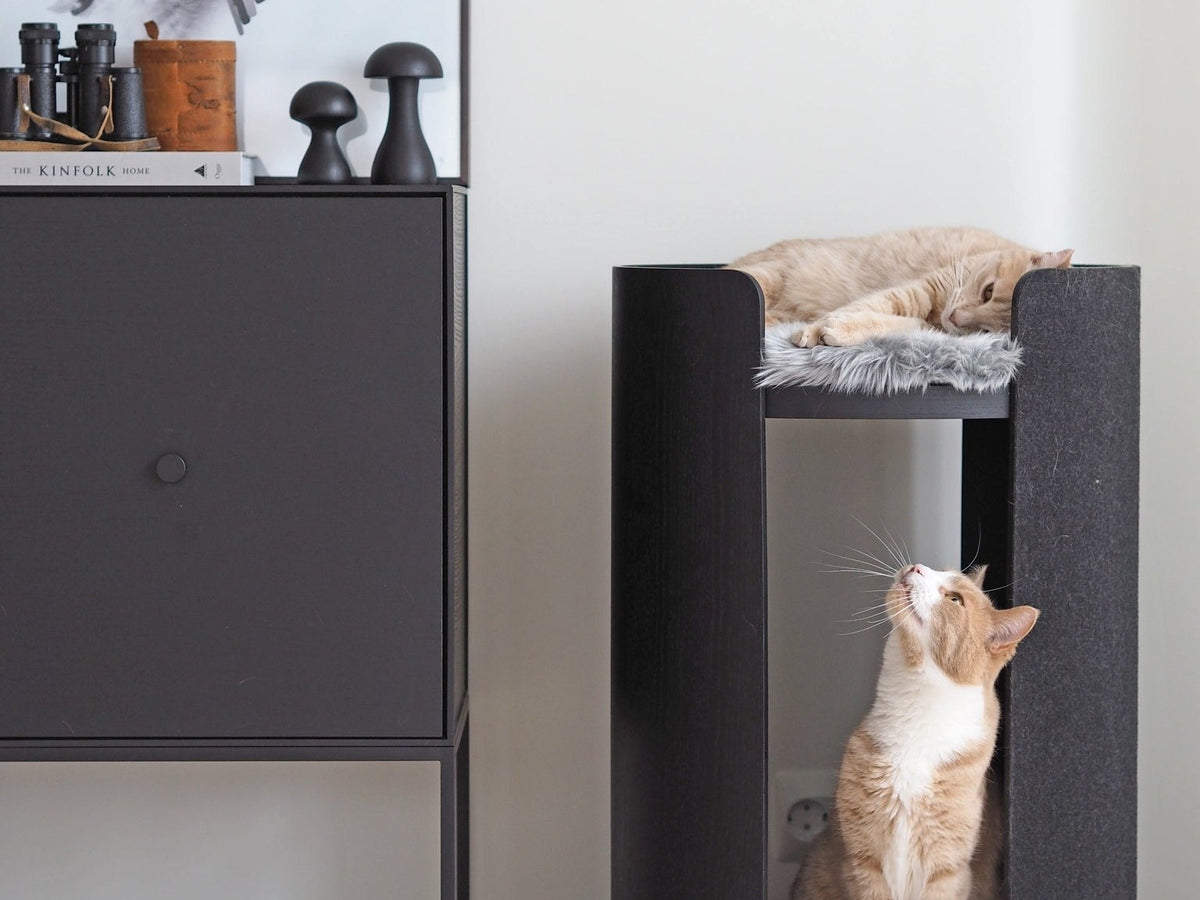
If you prefer a more sculptural piece, the Torre cat tower from the German design house MiaCara takes a different route to the same goal: a weighted base plate under a curved plywood panel wrapped in design felt. It comes in two sizes, 70cm tall at 11.55kg or 110cm tall at 21.7kg, both on a 45 x 45cm footprint. The cushion for its top platform is sold separately.
Beds a big cat can actually lie on
A large cat that cannot lie fully on a bed will sit on it briefly and then leave. Look at the footprint of each bed or platform, not the overall size of the tree, and compare it with how your cat lies on a sofa.
On the oak trees, the listings give each tree's overall footprint, not the size of each bed: 50 x 50cm for the one-bed tree, a maximum of 70 x 50cm for the two-bed, 85 x 54cm for the two-post tree, a maximum of 100 x 56cm for the three-bed and a maximum of 100 x 79cm for the four-bed. Every bed holds a fully washable cushion, which matters more with a big, long-coated cat than with a small one. The more beds a tree has, the more choice a large cat has about where to settle, and in a home with more than one cat the beds also become separate resting places rather than one contested spot.
A scratching surface long enough to stretch against
A scratching post should be "tall enough for your cat to scratch at full stretch" (Cats Protection), and International Cat Care advises that posts "should be as tall as possible to allow your cat to scratch vertically at full stretch" (International Cat Care). For a long cat, that rules out most short posts.
On the oak trees, the post is made from wood-based materials and covered in genuine natural sisal carpet, which is the scratching surface; the two-post tree gives two sisal posts. On the Torre, the scratching surface is the curved panel itself, wrapped in design felt; the 110cm size gives the longer stretch. If your cat also scratches horizontally, add a flat scratcher at floor level rather than expecting one piece to do everything; our guide to why cats scratch furniture explains why both directions matter.
Going up the wall instead
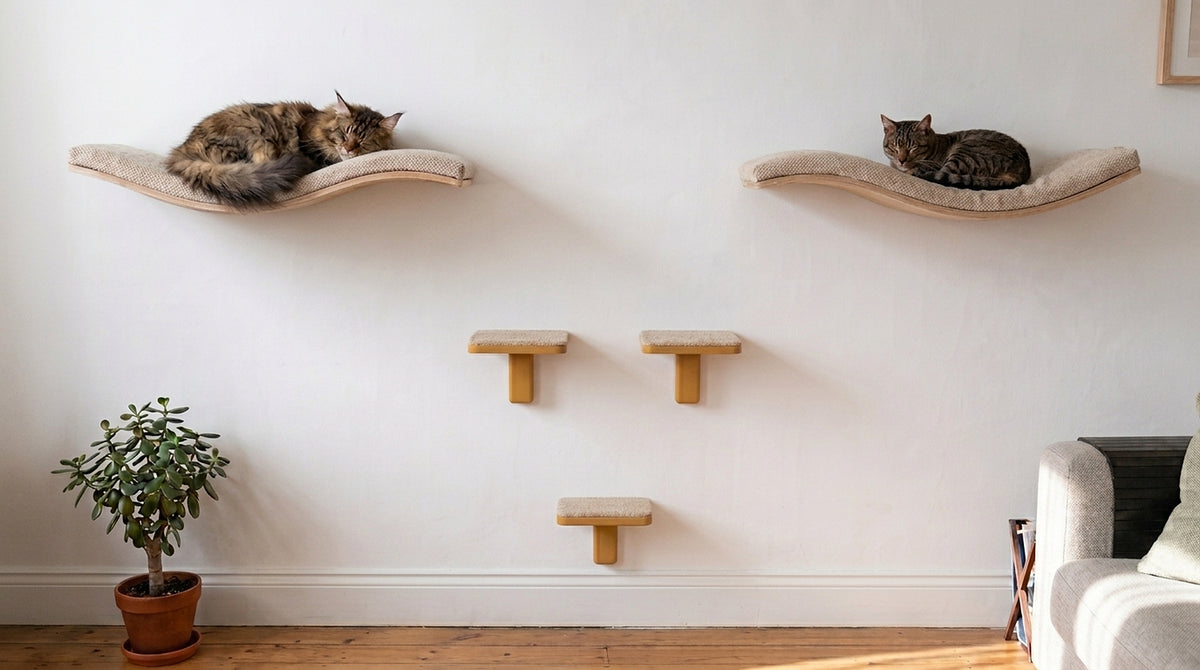
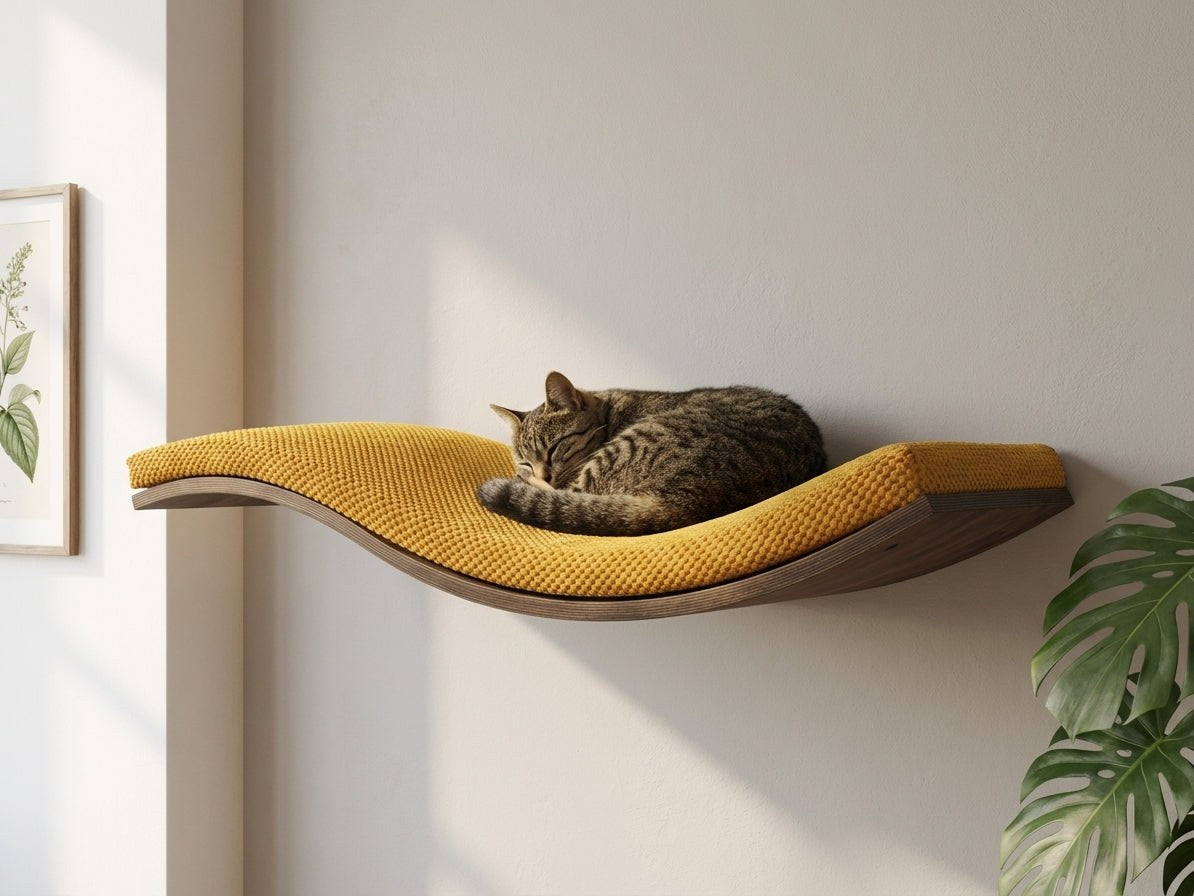
A floor tree is not the only way to give a large cat height. Wall shelves take no floor space at all, and the good ones state a load rating you can check against your cat. The Wave and the Playful Curve from Cat's Atelier are each rated to 25kg in the 75cm size and 40kg in the 95cm size, both 32cm deep. For a larger cat, or two cats sharing, the 95cm length gives more room to lie out. The Wavey Retreat is 95cm long and 37cm deep, rated to 40kg.
Two rules make a wall route work for a big cat. First, start low: the first step should be an easy hop from the floor, so the route is a climb, not a leap. Second, never stack steps directly on top of one another, because a cat needs to land beside the last step, not under the next one. For kittens, older or heavier cats, keep the gaps between steps to 20 to 30cm rather than the usual 30 to 40cm. If you would rather start from a planned layout, the Full Wall set pairs two 95cm Wavey Retreat shelves, each rated to 40kg, with three steps, and the cat wall builder helps you plan your own. Our guide to planning a floor-to-ceiling climbing route covers spacing in more detail.
Whatever you choose, a wall shelf is only as strong as its fixing. Fix into masonry, or into a stud on a plasterboard wall, following the instructions supplied, and check the fixings every few months.
The short version
- Check the weight before the height. A heavy base is what stops a tree rocking under a big cat.
- Look at the beds, not just the tree. Your cat should be able to lie flat out on at least one of them.
- Look for a scratching surface long enough for a full stretch.
- On the wall, choose shelves with a stated load rating, start low, and never stack the steps.
You can compare the trees side by side in our handmade oak cat trees collection, or browse our cat wall shelves if the wall suits your home better. If you are setting up a whole room around your cat, our catification guide takes it step by step, from the climb to a view, a scratcher and a retreat.
Frequently asked questions
Will a cat tree tip over with a large cat on it?
A tree tips when a heavy cat lands on an upper level and the base is too light to resist the force. Choose a tree whose weight is stated and substantial relative to its height. Our oak trees weigh about 20 to 30kg in all depending on the model, with the weight in a solid oak base and solid oak beds.
How big should the beds be for a large cat?
Big enough for your cat to lie fully stretched out, not just curled up. Compare the bed or platform footprint with the space your cat takes on a sofa cushion. A tree with several beds also gives a large cat a choice of resting places.
Are wall shelves strong enough for a Maine Coon?
Shelves with a stated load rating are. The Wave and the Playful Curve are rated to 25kg at 75cm and 40kg at 95cm, and the Wavey Retreat to 40kg, provided they are fixed into masonry or into a stud as the instructions describe. For a large cat, the 95cm length gives more room to lie out.