
Article: Catification: How to Catify Your Home, Step by Step
Catification: How to Catify Your Home, Step by Step
Catification means arranging your home so it works for your cat's instincts as well as for you. An indoor cat still wants to climb, watch, scratch, hide and hunt, and a home that gives each of those a place tends to be a calmer one. This guide is the practical version: seven steps, in order, with the measurements you need to plan a climbing wall and the smaller changes that finish the job.
What catification covers
This guide works through six needs: height, a private place, somewhere to scratch, a view, separate food, water and litter, and play. International Cat Care's guide to making your home cat friendly covers each of them, and is clear about the first: "Cats are natural climbers, and need to be able to rest and watch over their surroundings from high places". Catification does not create the instinct. It gives the instinct somewhere proper to go. Height is usually the biggest gap in an indoor cat's day, so most of this guide is about the wall. For the reasoning behind it, see our article on why cats want height.
Step 1: Walk round your home before you buy anything
Start by finding where your cat already does each of the six things. Go room by room and note:
- the highest place your cat reaches now, and how they get there;
- which window they watch from;
- where they scratch, including the furniture you would rather they left alone;
- where they go when they want to be left in peace;
- where the food, water and litter tray sit in relation to one another.
The answers tell you where each piece should go: the climbing wall in the room where your cat spends the day, the window seat at the window already in use.
Step 2: Choose the wall and measure it
You need three measurements: the height you can use, the clear width, and what the wall is made of.
- Height. A route that starts from the floor begins with a first step about 30cm up. In the suggested layouts for the wall sets in step 4, the main shelf sits at about 135cm from the floor, and the largest set adds a second shelf at about 170cm. Check there is still room over the top shelf for a cat to sit.
- Width. The shelves in the three sets are 75cm, 95cm and 100cm long, and each wall step is 10 x 21cm. The steps sit to the side of the shelf and of one another, so the route is wider than the shelf alone. Measure the clear run of wall between corners, doors, windows and switches.
- The wall itself. The shelves are made for a masonry wall or a plasterboard wall with studs. Find out which you have before you settle on a position, because on a stud wall the studs decide where the fixings can go.
A simple check before you commit: mark the suggested heights on the wall with low-tack tape, at about 30, 65, 100 and 135cm, plus 170cm if you are planning a second shelf, then live with the outline for a day or two. It shows you whether the route clears furniture, radiators and door swings.
Step 3: Plan the climb from the floor up
A cat needs a route, not just a destination. A single shelf fixed high on a wall looks right to a person, but a cat has to get there, and get down again, in a series of comfortable hops. Four rules make a route work.
Start from the floor
The first step should be low enough to be an easy hop from the floor. In our suggested layouts the lowest step sits about 30cm up.
Keep each climb short and even
Aim for climbs of around 30 to 40cm between one level and the next. Our guide to planning a floor-to-ceiling climbing route goes through spacing in more detail.
Never stack one step above another
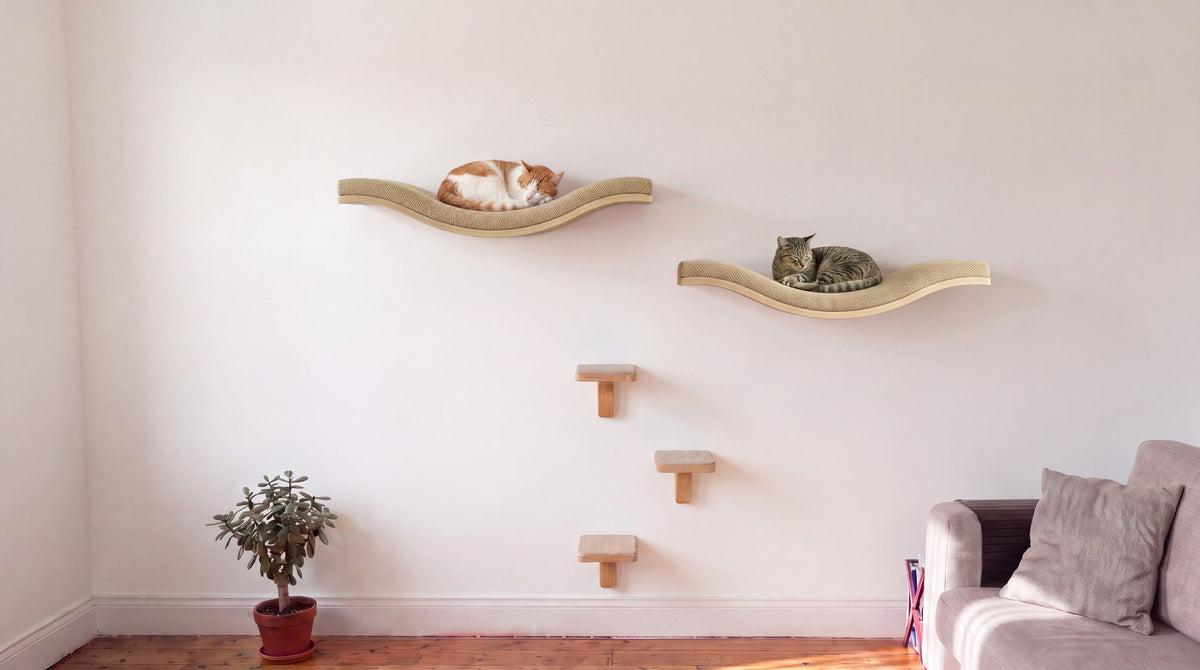
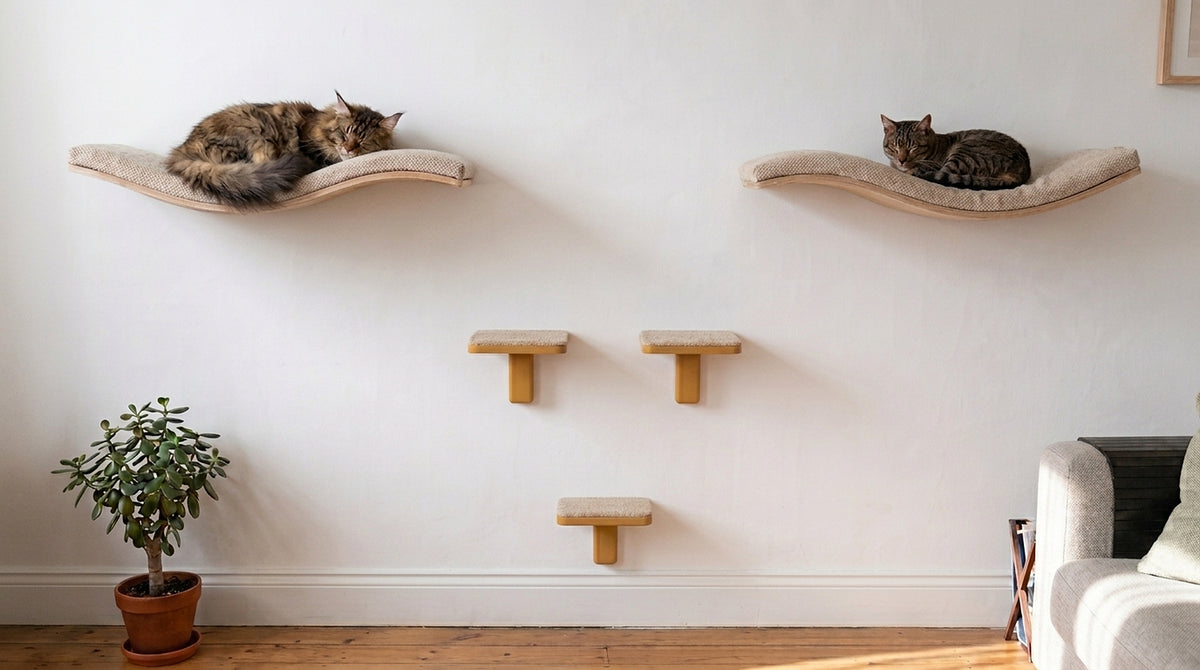
Each step should sit to the side of the one below it, never directly above, so that every level is a clear hop up and across from the last. A staggered line of steps is a staircase. A vertical column of them is not.
Finish on a shelf, not another step
The top of the route is where your cat rests, watches and withdraws. That is why the top level should be a full shelf with a cushion, long enough to lie on, and not simply one more step.
Kittens, older cats and heavier cats
For a kitten, an older cat or a heavier cat, close the gaps to 20 to 30cm. You can fit the steps of a wall set closer together than the suggested heights, which brings the shelf lower, or plan a custom route with an extra step so the top shelf stays where you want it.
Step 4: Pick a layout that fits the wall
The quickest way to a working route is a layout that has already been planned. Our three wall sets are built from Cat's Atelier shelves and steps. Each piece is made to order in Poland by Cat's Atelier. Every set comes with a suggested layout that follows the rules in step 3; the heights below come from those layouts, measured from the floor.
| Set | Shelf | Load | Best for |
|---|---|---|---|
| The Starter Climb | One Wave shelf, 75 x 32cm, with a full-length cushion | The 75cm Wave holds 25kg | One cat and a first climbing route |
| The Two-Cat Wall | One Double Arch Haven, 100 x 32cm, with one cushion across both arches | The Double Arch Haven holds up to 40kg | Two cats who share, or one cat who likes to stretch out |
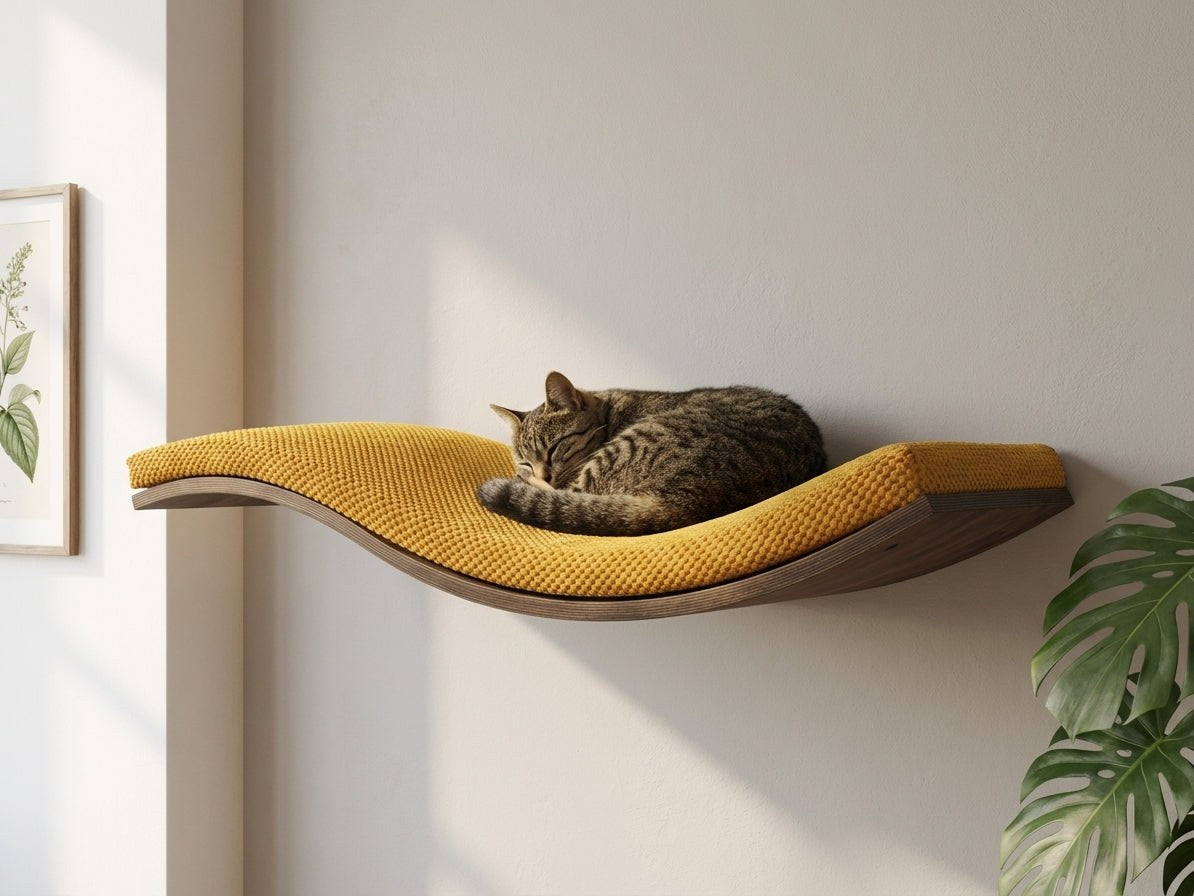
| The Full Wall | Two Wavey Retreat shelves, each 95 x 37cm, with full-length cushions | Each Wavey Retreat holds up to 40kg | A whole wall with two levels to rest on |
The Starter Climb: one shelf, three steps
The Starter Climb is three steps and one Wave shelf, 75 x 32 x 4cm, on a handmade metal frame with a full-length cushion in a washable cover. The suggested layout puts the steps at about 30, 65 and 100cm from the floor, each to the side of the last, with the shelf at about 135cm, so every climb is around 35cm. The 75cm Wave holds 25kg. The shelf cushion and base fabric are chosen separately. It suits a first route for one cat, or a narrower run of wall.
The Two-Cat Wall: a longer shelf to share
The Two-Cat Wall leads the same three steps up to the Double Arch Haven, a 100 x 32 x 4cm shelf in pre-bent metal with one cushion across both arches and a removable, washable cover. The Double Arch Haven holds up to 40kg and has room for two cats to share or each take a curve. The steps and shelf sit at the same heights as the Starter Climb; just allow for a shelf 25cm longer.
The Full Wall: two levels
The Full Wall adds a second level: three steps and two Wavey Retreat shelves, each 95 x 37 x 6cm. The Wavey Retreat is beech plywood with a full-length cushion and a removable, washable cover. The suggested layout puts one shelf at about 135cm beside the top step and the second at about 170cm on the other side. Each Wavey Retreat holds up to 40kg, and one wood finish is chosen for both. It needs the most wall in both directions, so measure the height first.
In all three sets the steps are the Cat Wall Step, 10 x 21cm, with an MDF core wrapped in felt on a metal bracket.
When a custom layout is the better choice
A set is a planned route that already works. Plan your own layout instead if:
- your cat needs shorter climbs than about 35cm and you still want a high shelf, which means adding steps;
- the wall is interrupted by a door, a radiator or a window, so the route has to turn or split;
- you want separate high spots on different walls for cats who prefer their own space;
- you want to mix wall pieces you have chosen individually.
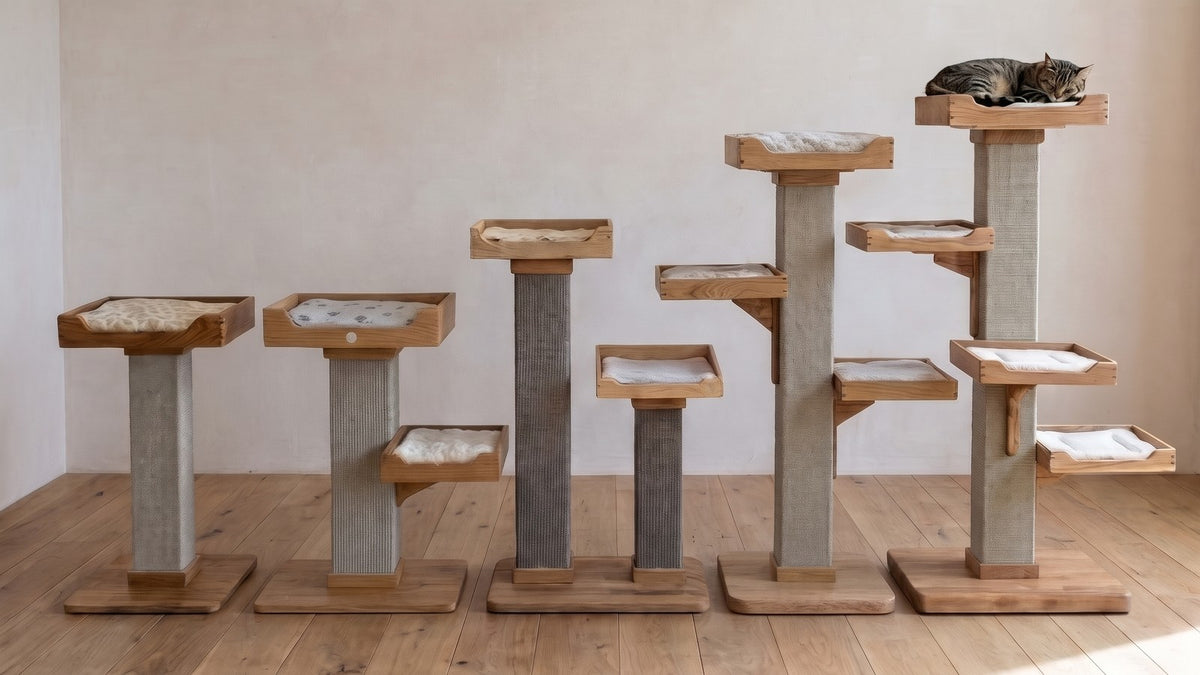
The cat wall builder lets you plan your own route, or you can browse all our cat wall shelves. If you would rather not fix anything to a wall, our handmade oak cat trees give height from the floor, with up to four beds.
Step 5: Fix it to the wall
The weight a shelf can hold only matters if the wall can hold it too. All three sets are wall-mounted with invisible fixings, and full fixings and fittings are included along with instructions. Work in this order:
- Mark every position in pencil first, lowest step to top shelf, using the suggested heights as your starting point.
- Check the marks against the rules in step 3: first step about 30cm from the floor, nothing stacked directly above anything else.
- Fit the pieces following the supplied instructions, into masonry or into the studs of a plasterboard wall.
- Let your cat find the route in their own time.
The structural elements of each set carry a two-year warranty.
Step 6: Give the window a seat
A window is where most indoor cats do their watching, but few windowsills are wide enough to lie on. A shelf fixed at the window turns the view into a resting place. The Sunny Spot is a pine shelf in 60cm or 75cm lengths that mounts with hooks and suction cups and holds 15kg. The Arcing View window hammock is a curved beech plywood shelf, 60cm long, that hangs at the window frame and is rated to 15kg, with a foam mattress in a cover that unzips for washing. Measure the window you noted in step 1, and see our guide to choosing and positioning a window shelf for which window to pick. Our cat window beds collection shows the window options side by side.
Step 7: Finish the room
Where to put a scratcher
Put a scratcher exactly where your cat already scratches. Cats Protection suggests "placing a scratching post next to the area where they've been scratching", and near where your cat sleeps, because "Cats often scratch and stretch when they wake up" (Cats Protection). Our guide to why cats scratch furniture explains the behaviour.
For a cat that scratches upright, the MiaCara Pannello is a wall panel with a powder-coated metal frame that fixes horizontally or vertically, and its scratching surface can be replaced on its own. For a cat that scratches along the floor, the MiaCara Gratta rests on the floor, with a replaceable cardboard surface in a lacquered wood frame measuring 60 x 30 x 10cm. On a climbing wall, the Round Sisal Cat Wall Step, a solid wood core in triple-braided sisal, is a foothold and a scratching place in one.
A place to retreat
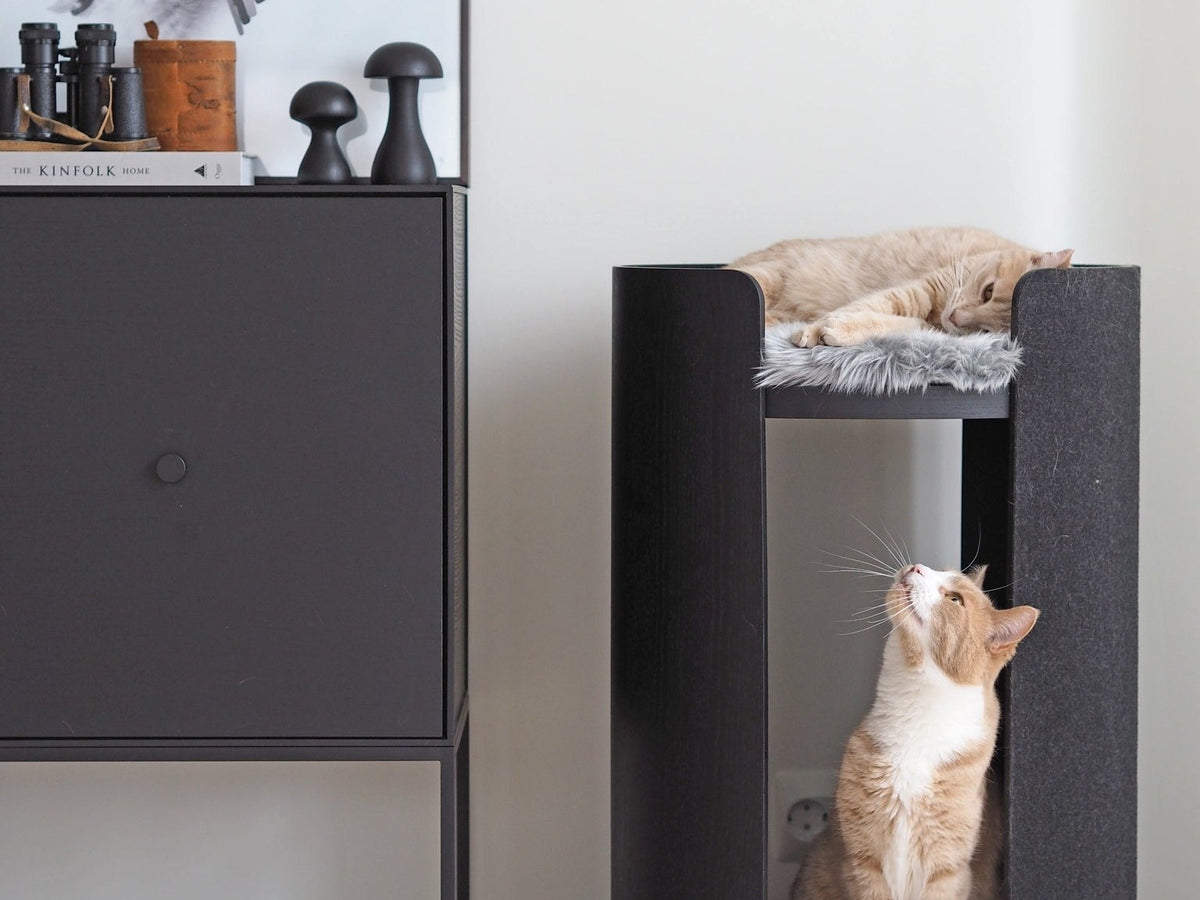
Every cat needs somewhere to withdraw, and International Cat Care is clear that "Your cat should never be disturbed while using a private area". Put an enclosed bed somewhere quiet, away from doorways and busy routes through the house. The MiaCara Perla is an enclosed cave in hand-braided rope or hand-woven rattan, with a removable cushion in a machine-washable cover, and the MiaCara Loggia sets a wool felt cave on a raised frame.
Food, water and litter
Spread them out. International Cat Care advises that "Each water bowl should have its own location within the home", and that the litter tray should sit "away from food and water, full-length windows and busy thoroughfares".
Play
A good route gives a cat somewhere to climb, rest and watch, but it does not replace play. International Cat Care notes that "Toys that move randomly are great; those that are motionless and left lying around soon become predictable and boring". A few minutes a day with a moving toy belongs in any catification plan, however good the wall is.
Catification with more than one cat
In a home with two or more cats, the number of separate places matters more than the number of things. International Cat Care's advice on water bowls is about giving each one its own location, and the same thinking applies to height. Two shelves on different walls are two uncontested places. Two shelves side by side can still be one contested space. On one wall, the Full Wall's two levels at different heights give two cats a choice; for cats who prefer their own space, separate walls are better. Our guide to multi-cat households covers this in more detail.
The catification checklist
- Walk round your home and note where your cat climbs, watches, scratches, hides and eats.
- Measure the wall: usable height, clear width, and masonry or studs.
- Plan the climb: first step about 30cm from the floor, climbs of 30 to 40cm, steps to the side and never stacked, finishing on a cushioned shelf.
- Pick one of the three wall sets, or plan your own layout with the cat wall builder.
- Mark the positions, check them, then fix with the fittings supplied.
- Give the window a seat.
- Place a scratcher where the scratching happens and a retreat somewhere quiet, spread out food, water and litter, and play every day.
Frequently asked questions
What is catification?
Catification means arranging your home so it meets a cat's natural needs: somewhere high to climb and rest, somewhere private to retreat, a place to scratch, a view, separate food, water and litter, and regular play. It is usually a few well-placed pieces rather than a room full of cat furniture.
How do I catify a room with wall shelves?
Choose a wall in the room your cat uses most, then build a route from the floor to a resting shelf. Put the first step about 30cm from the floor, set each following step to the side of the last, never directly above it, with climbs of 30 to 40cm, and finish on a cushioned shelf, which sits at about 135cm in our suggested layouts. A ready-planned set such as the Starter Climb, the Two-Cat Wall or the Full Wall gives you the route and a suggested layout in one.
What kind of wall can cat wall sets be fixed to?
The Cat's Atelier wall sets are made for a masonry wall or a plasterboard wall with studs. Full fixings and fittings are included with instructions, and the fixings are hidden once the pieces are up.
How much weight can the shelves in the wall sets hold?
The 75cm Wave shelf in the Starter Climb holds 25kg. The Double Arch Haven in the Two-Cat Wall holds up to 40kg, and each Wavey Retreat in the Full Wall holds up to 40kg.
Do I need a custom layout for a kitten or an older cat?
Not always. Kittens, older cats and heavier cats are best with climbs of 20 to 30cm rather than the 35cm in the sets' suggested layouts. You can fit a set's steps closer together, which brings the shelf lower, or plan a custom route with an extra step so the top shelf stays high.
Is a cat wall enough enrichment on its own?
No. A wall route covers climbing, resting and watching. A cat also needs somewhere to scratch, a private place to retreat to, food, water and litter kept in separate places, and daily play with toys that move.