

Article: How to Choose and Position a Cat Window Perch
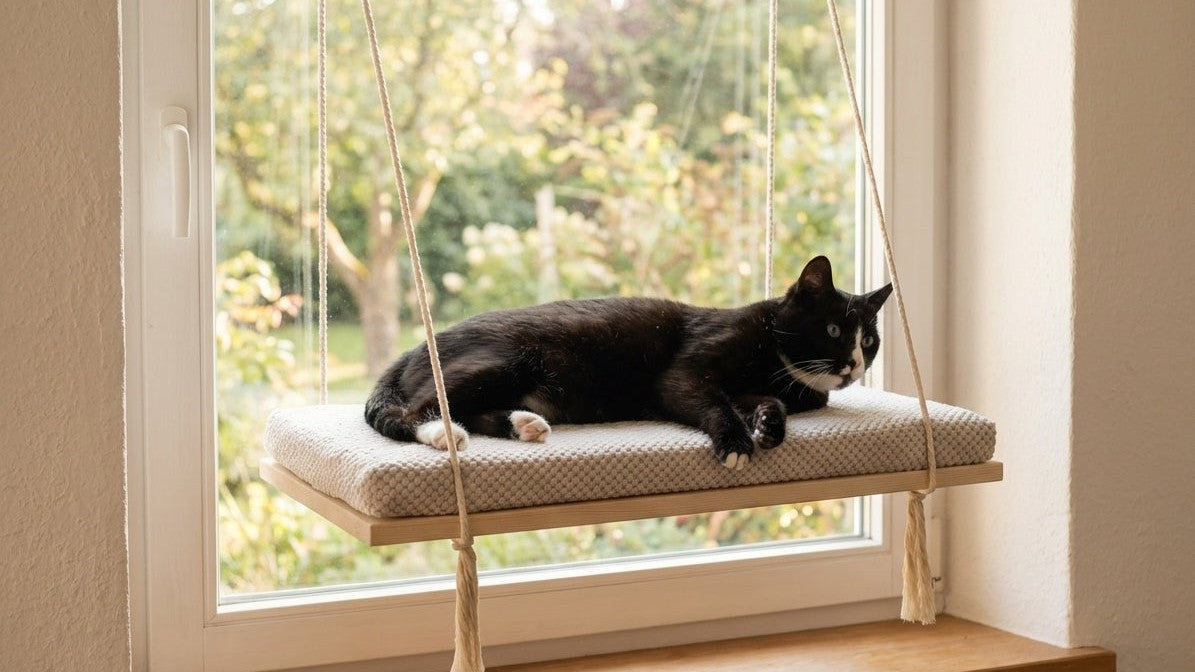
How to Choose and Position a Cat Window Perch
Watch a cat for an afternoon and you will find them at a window sooner or later. Birds in the hedge, a neighbour's car, leaves moving, the light shifting across the room: for an indoor cat especially, the window is where the day happens. A window perch turns that habit into a proper place to settle, instead of a narrow sill they balance on or the back of the sofa they are not supposed to be on. Choosing one well comes down to two questions: how it holds on to your window, and where you put it.
Why cats want a high spot by the glass
Cats like to rest where they can see what is going on without being in the middle of it. International Cat Care, the feline welfare charity, puts it plainly in its guide to making your home cat friendly: cats "need to be able to rest and watch over their surroundings from high places", and it suggests you "make sure your cat has a high perch somewhere near the window where they can look outdoors from a safe position".
That last phrase is the one to hold on to. A good window perch gives your cat the view and the height, and it also gives them a spot that feels secure: somewhere they can settle fully, rather than keeping half an eye on staying upright.
How a window perch holds on: the question that matters most
Most of the difference between window perches is in the fixing, so start there before you look at colours and cushions.
- Suction-cup perches hold on to the window pane itself. They are quick to put up and take down. If you choose one, read the maker's instructions on which windows it suits and how to prepare the surface, and test it with your hand before your cat does.
- Frame-hung perches hang from the window frame, so the cat's weight goes into the frame rather than the pane. The Sunny Spot, The Arcing View and The Arcing View hammock all work this way: each hangs from the frame on stainless steel hooks, with suction cups that sit against the glass to steady the shelf. On The Arcing View, the suction cups carry none of the weight at all; the hooks on the frame do.
- Sill-supported and freestanding perches rest on the sill or stand on the floor in front of the window. They need a deep enough sill, or floor space in front of the window.
Whichever type you choose, check the stated maximum load against your cat. Our window perches are rated to 15 kg, which leaves plenty of margin for a typical domestic cat, including one who lands with some enthusiasm.
Measure the window before you choose
Two measurements decide what will fit. First, the frame: a frame-hung perch needs a frame it can hook onto, so look at where the hooks will sit and make sure nothing (a blind, a handle, a trickle vent) is in the way. Second, the width of the window you want the perch in front of.
Then think about depth. A typical windowsill is too narrow for a cat to lie out fully, which is why so many cats end up balanced on the edge with their tail hanging over the drop. A perch around 30 cm deep gives room to curl up or sprawl. Ours are 32 cm deep, and come in 60 cm lengths, with The Sunny Spot also available at 75 cm for a wider window or a cat who likes to stretch out along the full length.
Flat or curved?
This is a question of how your cat likes to sleep.
- A flat shelf suits the sprawlers: cats who lie on their side, legs out, soaking up the sun. The Sunny Spot is a flat pine shelf with a full-length cushion, and the wood finish is chosen separately from the fabric.
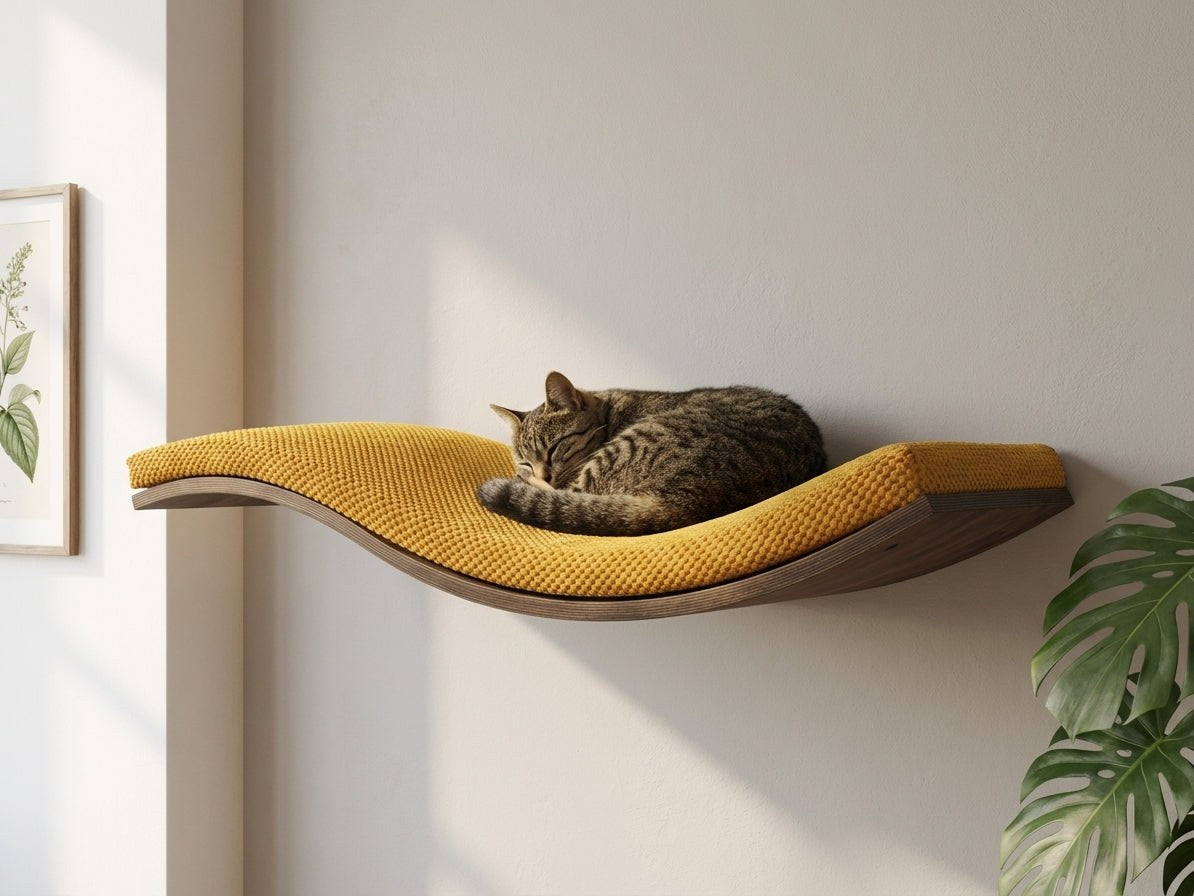
- A curved shelf suits the curlers. On The Arcing View hammock, a beech plywood shelf shaped to a gentle curve, the cushion sits inside the arc, deep enough that a curled cat sinks below the rim and feels enclosed rather than exposed.
If you are not sure which your cat is, watch where they choose to sleep now. A cat who wedges themselves into the corner of a box or the arm of a chair is telling you something.
Whatever the shape, the surface should grip. International Cat Care notes that it is "important to provide a non-slip surface, as many wooden shelves are extremely slippery", which is one reason a cushion on a window perch is doing real work, not just looking comfortable. Removable, washable covers make it far easier to live with, since a well-loved perch collects fur quickly.
Where to position it
Pick the window your cat already uses. The best predictor of a perch being used is a cat already trying to sit there. If they squeeze onto one particular sill, or sit on the floor staring out of one particular door, start with that one.
Follow the sun. Cats like warm places to sleep. In the UK, a south-facing window gets the most direct sun through the day, a west-facing one catches the afternoon, and an east-facing window suits an early riser. A north-facing window is cooler but can have the more interesting view.
Think about the view, and what is in it. A garden, a bird feeder, a quiet street with some movement all make a window worth sitting at. A cat can see what is outside without understanding that the window keeps it out, so a view can unsettle as well as entertain: a neighbour's cat patrolling the garden is the classic example. For large windows, International Cat Care suggests putting some potted house plants near the window to provide enough camouflage for your cat to feel safe.
Give them a way up. A perch at sill height is easy to reach from the floor. If yours sits higher, make sure there is a comfortable route: a nearby piece of furniture, or a wall shelf or step to jump from. When you plan steps up to a window, stagger them sideways rather than stacking one directly above the other, so a cat jumping up never has a shelf over their head. Our guide to planning a floor-to-ceiling climbing route goes through the spacing in detail.
Keep it clear of the things you need to open. Make sure the perch does not stop a window or blind from being used, and that curtains will not drape over it when they are drawn.
Helping your cat use it
Most cats need no persuading once a perch is in the right window. If yours is hesitant, put something that smells of them on the cushion, such as a blanket they sleep on, and leave it to them. Let them find it in their own time rather than lifting them onto it.
Check the fixings every so often, particularly in the first few weeks after installation as everything settles, and wipe the frame down when you wash the cover.
A window perch as part of a wider cat wall
A window perch works well on its own, and it works even better as one stop on a route around the room. If you are building out vertical space more generally, our piece on why cats need vertical space covers the reasons, and you can see our window perches alongside wall shelves, steps and bridges in the cat shelves and climbing collection. Each of our window perches is handmade to order by Cat's Atelier in Poland.
Frequently asked questions
Are cat window perches safe?
It depends mostly on how the perch is fixed and whether it is rated for your cat's weight. A frame-hung perch carries the weight through hooks on the window frame rather than through suction alone. Whatever type you choose, check the stated maximum load, follow the fitting instructions, and check the fixings every so often, particularly in the first few weeks.
Which window is best for a cat perch?
Start with the window your cat already tries to sit at. After that, look for sun and something to watch: in the UK a south-facing window gets the most direct sun, and a view of a garden or bird feeder makes a window worth sitting at. Make sure the perch does not block a window or blind you need to open.
How deep should a cat window perch be?
Deep enough for your cat to lie down fully rather than balance. A typical windowsill is too narrow for that; a perch around 30 cm deep gives room to curl up or sprawl. Our window perches are 32 cm deep and 60 cm long, with The Sunny Spot also available at 75 cm.